The Alaska Board of Game voted unanimously to continue predator control programs in the state, and expand effort in one of the areas.
The board met to consider whether to make permanent emergency regulations adopted in January to allow the programs struck down by the court to continue. The programs were halted because of technical flaws in the process of adopting the regulation.
The programs are designed to improve moose and caribou populations in areas where their numbers have been reduced by wolf predation. Read the entire ADFG news release >>>
The state's wolf control program is now the largest in recent decades, the Anchorage Daily News reported, and the board's decisions now allow relaxed regulations for taking bears.

Thursday, May 18, 2006


State to burn part of Nenana Ridge for grouse
The Alaska Departments of Fish and Game and Natural Resources and the Ruffed Grouse Society are working together to burn portions of Nenna Ridge to benefit grouse. The 46 acre burn must occur after snowmelt but before leafout, so the window is very short.
The project is designed to kill the older aspens so as to allow new stands of young aspens needed by young grouse. Read the entire news release >>>
The project is designed to kill the older aspens so as to allow new stands of young aspens needed by young grouse. Read the entire news release >>>
Thursday, May 04, 2006
Are fishers moving into Alaska?
Alaska Wildlife News (AWN) reports in the May issue that fishers, a large cousin of the familiar Alaska marten, appear to be moving into SE Alaska.
AWN reported that ADF&G Juneau Area Biologist Neil Barten said he’s learned of three more fishers that were trapped in recent years, including a second animal trapped by Nelson. Barten now has one animal in the freezer at the Douglas Fish and Game office that came from the Taku River, near Grizzly Bar, and Barten hopes to take some genetic information from that animal. Others came from the Eagle River area.
“It would be interesting to see what the source population is, and if the fishers moving into Southeast are from the same source population,” Barten said in the AWN article. “I don’t doubt there are a few more around.”
AWN reported that ADF&G Juneau Area Biologist Neil Barten said he’s learned of three more fishers that were trapped in recent years, including a second animal trapped by Nelson. Barten now has one animal in the freezer at the Douglas Fish and Game office that came from the Taku River, near Grizzly Bar, and Barten hopes to take some genetic information from that animal. Others came from the Eagle River area.
“It would be interesting to see what the source population is, and if the fishers moving into Southeast are from the same source population,” Barten said in the AWN article. “I don’t doubt there are a few more around.”
Blue grouse hunting going in SE Alaska
"Blue grouse are chicken-sized birds closely related to ptarmigan. Weighing about 3 pounds, they are the largest of the four species of grouse in Alaska and they are the only grouse found in the Juneau area. They are year-round residents of Southeast Alaska, and although they don't migrate, they do move up and down the mountain slopes."
ADF&G writer Riley Woodford writes regularly for the Juneau Empire, and this is part of what he wrote about this largest of Alaska's game birds, and their spring habits. The spring hunting season is open until 15 May.
ADF&G writer Riley Woodford writes regularly for the Juneau Empire, and this is part of what he wrote about this largest of Alaska's game birds, and their spring habits. The spring hunting season is open until 15 May.
Wednesday, May 03, 2006
State wolf control efforts fall short
The Fairbanks Daily News-Miner reports that the efforts by private gunner teams to take up to 400 wolves only resulted in 153 reported wolves.
The paper cited state officials as saying that high fuel prices, a court ordered cessation of the program for a week in January, and a temporary closure because of the Iditarod sled dog races were all factors in the smaller than hoped for take of wolves.
Still, state officials say that the program is already having an effect in reduced wolf numbers and improved moose survival.
The paper cited state officials as saying that high fuel prices, a court ordered cessation of the program for a week in January, and a temporary closure because of the Iditarod sled dog races were all factors in the smaller than hoped for take of wolves.
Still, state officials say that the program is already having an effect in reduced wolf numbers and improved moose survival.
Dalton Highway ORV bill killed in committee
A bill which would have opened the Dalton Highway (Haul Road) corridor to off road vehicle use has died in the House Transportation committee, according to the Fairbanks Daily News-Miner.
"The legislation sponsored by Fairbanks Republican Sen. Ralph Seekins would remove a prohibition on the use of snowmachines and four-wheelers in a five-mile corridor along the Dalton Highway that's been in place since the road was built," the News-Miner reported.
"The legislation sponsored by Fairbanks Republican Sen. Ralph Seekins would remove a prohibition on the use of snowmachines and four-wheelers in a five-mile corridor along the Dalton Highway that's been in place since the road was built," the News-Miner reported.
The vote was 3-2 opposed. Senator Seekins, the bill's sponsor has vowed to bring the bill up again next session.
Revised hunting forum now online
New forum software is online now for the Alaska hunting forum and other forums on OutdoorsDirectory.com The new forum software is in a separate location from the long standing Alaska outdoor forums. Both the new and existing forums will be allowed to run concurrently for a time while the new software is being evaluated.
The new software is much more flexible for users, providing three different views of forum messages, among other new features. There are also now additional forums, including a bowhunting forum under the main hunting forum, and forums for mountain biking, hiking, and various types of Alaska boating.
The new software is much more flexible for users, providing three different views of forum messages, among other new features. There are also now additional forums, including a bowhunting forum under the main hunting forum, and forums for mountain biking, hiking, and various types of Alaska boating.
Sunday, April 30, 2006
Recent Threads on the Alaska Hunting Forum
- AlaskaCub wants an update on how hunting has been going on Kodiak for brown bears.
- John S shares his story about a black bear hunt that ended with a surgeon cutting his hand open.
- AK375HH wants to know what's on your list of gear for a PWS black bear hunt.
- FBKShunter starts a hot discussion about subsistence waterfowl hunting.
- AlaskaCub is curious what to do about decoy tents?
- BRWNBR gives his two cents about his first experience with a single wall tent.
Wednesday, April 26, 2006
AK Outdoor Council alert
The Alaska Outdoor Council is advising hunters and anglers that the proposed budget allocation for the Alaska Department of Fish and Game is insufficient and could diminish future hunting and fishing opportunities.
Here is the text of the alert:
Please contact Legislators TODAY!
Decisions will be made this week!
Without adequate funding Intensive Management may fail…and your hunting opportunity may fail, too.
House and senate finance committees have provided the Wildlife Conservation Division, ADF&G, with only part of the funds necessary to carry out the survey and inventory work that supports predator management. An additional fund of $1.6 million in General Funds is needed as a Capital Budget allocation.
Without full funding of a survey of the socio-economic aspect of recreational fishing in Alaska the Board of Fisheries will continue to use 13 year old data to allocate fish harvest among personal use, sport, guided sport, and commercial.
The rules governing the allocation of fishery resources says the board shall adopt criteria for allocation of fishery resources and shall use the criteria as appropriate to the particular allocation decisions. The factors included in the criteria are determined by the data gathered from this survey. An additional $200,000 from our own Fish & Game Fund is needed.
Please contact the legislators listed below TODAY with a message something like this—
Dear Senator_____________________
Please approve capital budgets requests to ensure that predator management plans can be implemented under Alaska’s Intensive Game Management Law and completion of a 2007 Economic/Satisfaction Survey for Sports Fish Division can be conducted.
And please give the Board of Game funds to work with the public to fix the Tier II regulation mess in the Nelchina Basin.
Thank you.
Senator_Lyda_Green@legis.state.ak.us -- 877-465-6601
Senator_Gary_Wilken@legis.state.ak.us == 907-465-3709
Senator_Con_Bunde@legis.state.ak.us –
Senator_Gene_Therriault@legis.state.ak.us – 800-860-4797
Senator_Ralph_Seekins@legis.state.ak.us – 800-336-7383
Senator_Fred_Dyson@legis.state.ak.us – 800-342-2199
Here is the text of the alert:
Please contact Legislators TODAY!
Decisions will be made this week!
Without adequate funding Intensive Management may fail…and your hunting opportunity may fail, too.
House and senate finance committees have provided the Wildlife Conservation Division, ADF&G, with only part of the funds necessary to carry out the survey and inventory work that supports predator management. An additional fund of $1.6 million in General Funds is needed as a Capital Budget allocation.
Without full funding of a survey of the socio-economic aspect of recreational fishing in Alaska the Board of Fisheries will continue to use 13 year old data to allocate fish harvest among personal use, sport, guided sport, and commercial.
The rules governing the allocation of fishery resources says the board shall adopt criteria for allocation of fishery resources and shall use the criteria as appropriate to the particular allocation decisions. The factors included in the criteria are determined by the data gathered from this survey. An additional $200,000 from our own Fish & Game Fund is needed.
Please contact the legislators listed below TODAY with a message something like this—
Dear Senator_____________________
Please approve capital budgets requests to ensure that predator management plans can be implemented under Alaska’s Intensive Game Management Law and completion of a 2007 Economic/Satisfaction Survey for Sports Fish Division can be conducted.
And please give the Board of Game funds to work with the public to fix the Tier II regulation mess in the Nelchina Basin.
Thank you.
Senator_Lyda_Green@legis.state.ak.us -- 877-465-6601
Senator_Gary_Wilken@legis.state.ak.us == 907-465-3709
Senator_Con_Bunde@legis.state.ak.us –
Senator_Gene_Therriault@legis.state.ak.us – 800-860-4797
Senator_Ralph_Seekins@legis.state.ak.us – 800-336-7383
Senator_Fred_Dyson@legis.state.ak.us – 800-342-2199
Alaska Board of Game to meet again May 10-12
The Alaska Board of Game will meet on May 10 - 12 in Anchorage as an extension of the Fairbanks, Interior Region meeting that was held in March. The board will address a number of proposals relating to the state's predator control programs that were deferred from the March meeting.
The board will not take public comment, but written comments will be accepted.
The board will not take public comment, but written comments will be accepted.
Sunday, April 23, 2006
More Hot Threads from the Alaska Hunting Forum
- Father of 2 wants to know if you think the record books are good or bad for hunters?
- RobR is seeking comments on a proposal for a bonus point system for Alaska permit drawings.
- AlaskaCub is comparing the Zeiss Conquest vs the Leupold VXIII?
- blackfoot wants to know how you store your tent between hunts?
- homerdave questions what it is that out-of-state hunters find appealing or compelling about hunting in Alaska.
- akhunter02 starts a discussion about Fair Chase hunting across america using a hunt he saw on the Outdoor Channel as an example.
- ak hunter is looking for sleeping bag suggestions for his sheep hunt.
- ak hunter wants to know what headlamp you use for a sheep hunt.
- Casper50 is buying a satelite phone and would like suggestions.
- Ak Steve is pondering a bear hunt in the Sound by kayak, has anyone else ever tried this?
Friday, April 14, 2006
Hot Threads on the Alaska Hunting Forum
- muskeg starts a very hot discussion and debate about the proposed changes to hunting license and tag fees.
- Michael Strahan has the highlights of the Alaska Sportsman Show.
- Michael Strahan wants to know how you go about shooting an animal?
- ak hunter gives his two cents about the two rams that were killed along the Seward Highway.
- Jeff L is taking his father and son on a blackie hunt and would like to know whether boat or air gives the best opportunity for spring bear.
- sheephunter2000 needs bear bait suggestions.
- Water_Gremlin would like to know techniques used for calling in coyote or wolves.
- El cuchillo wants any fox recipes you may have for a wild cooking book.
- Elkwhisper wants to know if he needs crampons for a Kodiak goat hunt.
- BruceB is planning a trip for caribou out of Kotz in the fall of '07. Any insight would be appreciated about Cabela's booking service and caribou hunts in the Kotz area.
- FALCON would like to know if gaiters are necessary on a sheep hunt?
- Alaskacanoe brings to light the topic of leaving meat for donation in communities hunted out of.
Wednesday, April 12, 2006
Float Hunting Alaska's Wild Rivers - Interview
OutdoorsDirectory.com's David Johnson recently interviewed Michael Strahan about his soon-to-be published book, Float Hunting Alaska's Wild Rivers. The 400+ page book is based on Strahan's extensive research on dozens of Alaska Rivers and his own experience as a float hunter and guide. Alaska Hunter publications is now accepting pre-publication orders of the book on their website, and the book is expected out sometime mid 2006.
Tuesday, April 11, 2006
2006/2007 Hunting Regulations Summary
Wildlife Tech (from the Alaska Hunting Forum) has supplied a copy of the changes made by the Alaska Board of Game to the Alaska Hunting Regulations for 2006/2007. He asked me to pass on that this is an accurate list, but is certainly not polished.
He also passed along a copy of the new proxy hunting rules.
He also passed along a copy of the new proxy hunting rules.
Monday, April 10, 2006
State Seeks Wolf Control For Fortymile Country
The State of Alaska is proposing a wolf control program to boost caribou numbers in the Fortymile Caribou Herd, according to the Anchorage Daily News. The Fortymile caribou herd has stopped growing after it reached 43,000, double the numbers of eight years ago.
"The growth of that herd has stopped and the reason is more animals are dying," the Associated Press quoted Fairbanks ADFG information officer Cathie Harms. "We're relatively confident that the increase in mortality is due to predation."
The proposal was made at the Alaska Board of Game meeting earlier in April, but was tabled for consideration at a special board meeting to be held in May.
ADFG Shooting Sports Travels to SE Alaska
The Alaska Department of Fish and Game's mobile shooting sports program has announced a six community Southeast Alaska tour for April, May and June. Programs will be offered in Juneau starting in late April, followed by programs in Sitka, Ketchikan, Wrangell, Petersburg and Haines. The programs will include muzzleloader education, map and compass, reloading, steel shot, and archery.
Moose Researchers Find Plants Fight Back
Alaska Wildlife News reports that ADFG researchers are learning that plants browsed by moose can fight high levels of browsing by producing chemicals that interfere with digestion.
"Moose in the Nelchina Basin in Southcentral Alaska were showing signs of nutritional deficiencies, although they were surrounded by willow species that are normally considered high quality forage. When biologists Bill Collins and Don Spellinger looked at the plants the moose were eating, they discovered the willows were producing chemicals that interfered with the animals’ ability to digest leaves and twigs," wrote Riley Woodford in the News.
Biologists used tamed moose to better understand what is happening.
"Moose in the Nelchina Basin in Southcentral Alaska were showing signs of nutritional deficiencies, although they were surrounded by willow species that are normally considered high quality forage. When biologists Bill Collins and Don Spellinger looked at the plants the moose were eating, they discovered the willows were producing chemicals that interfered with the animals’ ability to digest leaves and twigs," wrote Riley Woodford in the News.
Biologists used tamed moose to better understand what is happening.
GMU 19A Predator Control Program Closed
The Department of Fish and Game has closed the GMU19A predator control program according to an agency news release. The agency reported that the wolf population had been reduced to the desired level, so the season on wolves was closed as of April 3rd. The implementation plan required that 40-53 wolves remain in the unit from a mid winter total of 114-120. The closure was made to prevent reducing the population below the goal. This is the second of five years of a predator control program approved in 2004 in 19A.
Friday, April 07, 2006
Pro Pioneer Interview with Larry Bartlett
 We ran into Pro Pioneer developer Larry Bartlett at the Great Alaska Sportsman's Show in Anchorage on 7 April. We talked about the unique watercraft he is selling for Alaska conditions.
The Pro Pioneers are long and narrow and designed for substantial payloads. You can read more about them on the Pristine Ventures website.
Larry Kaniut's New Book on Alaska Bear Safety
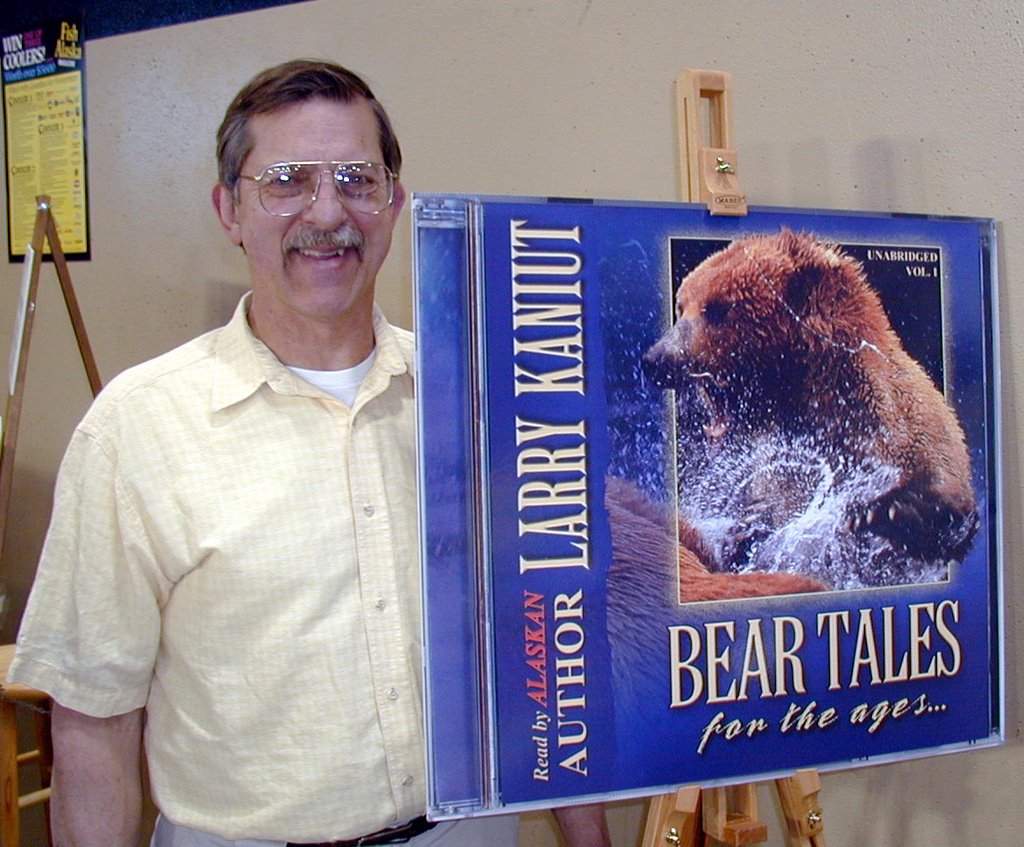 Alaska author Larry Kaniut is well known for his books of stories about Alaska bears -- especially bears who have chewed up Alaskans. Kaniut has a new book on tap -- and this one incorporates his understanding of bear attacks and suggests some strategies for dealing with potentially lethal bear encounters.
Alaska Outdoors Advocacy - The Alaska Outdoor Council
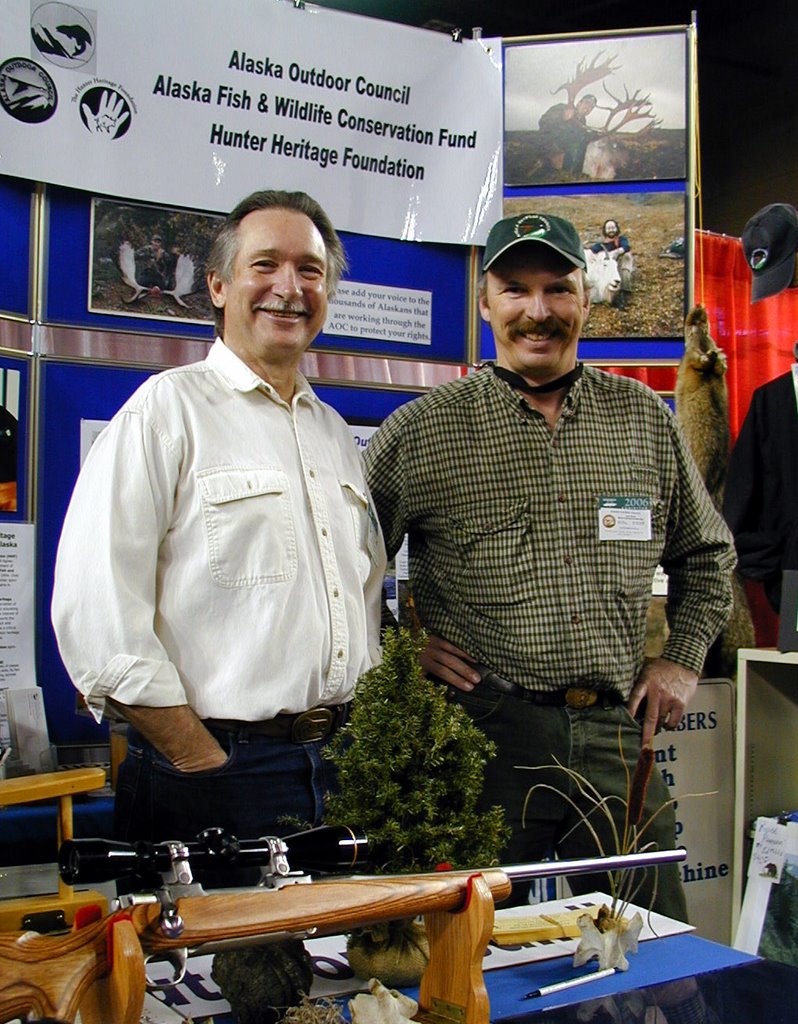 We met up with Alaska Outdoor Council Executive Director Rod Arno at the Great Alaska Sportsman's Show on April 7. Arno and I talked in the interview about the council and why Alaskans and others interested in the Alaska out of doors should consider joining the ranks of membership, either through an affiliated club, or as an individual member.
Oar Saddles - world's lightest rowing frame

The Oar Saddle isn't really a rowing frame, but it does many of the same tricks. If you are considering a river trip where a frame is needed -- but can't take the weight and bulk of a full-size frame, these are definitely worth a look.
Inventor Kent Rotchy tells how they work, where they don't work, and how you can find out more.
Monday, April 03, 2006
Buffoose in Delta Junction?
 Alert Delta Junction residents sent The Alaska Hunting News this picture published in Saturday's Delta News Web, and the accompanying cutline:
Biologists have been concerned about the potential for interbreeding among moose (Alces alces) and bison (Bison bison). Delta is one of the areas in the world where these two species exist in close geographic proximity. Delta area biologist Steve DuBois captured images of what may be the first known instance of a hybrid between these two species. The body of this animal appears moose-like, but the horns appear to be typical of a male bison. It is not known whether this "bull" is sterile, as hybrids often are. Biologists and lexicophilists are working on names for the new hybridized species. Some that have been proposed are buffoose, moosalo, boose, mison, bioose, bisoose, and mooson. A debate is raging among taxonomists on what Latin name to use: Alces buffaloensis, Bison alces, or something entirely new, Aprilfoolsensis critterus. Photo Courtesy Steve DuBois.
Friday, March 31, 2006
Legislative proposal to fund ADFG inadequate: AOC
The Alaska Outdoor Council has called legislative committe proposals to fund ADFG work inadequate. In light of increasing expenses, inadequate salaries to attract the best candidates, and spiraling overhead costs, the AOC is urging Alaskans to support higher funding for the Divisions of Sport Fisheries and Wildlife Conservation.
Thursday, March 23, 2006
Recent Threads on the Alaska Hunting Forum
- alwaysgoing wants to know about the bugs north of the Brooks Range!
- AlaskaCub would like to know if there is any special tricks to care for guns in the saltwater environment on the Alaska Peninsula.
- Jake_65_65 wants to get practiced in the event of a bear charge as far shooting techniques.
- Michael Strahan has some inside information on Adak caribou hunting.
- 9point needs some pointers on how to dry hip boots on a drop hunt.
- LaneW would like recommendations for equipment to take digital pictures through a spotting scope.
- Mr. Grayling is planning a hunt in the Wrangells and would like to know where he can hunt for sheep.
- bizymocha needs a good bannock recipe for in the field.
- 375ultramag is addressing the changes to moose hunting in unit 21D.
- ward17 would like some feedback regarding Joe Want's bear hunting seminars.
- Mr Grayling is going sheep hunting in fall; what exercise and training tips would you give him.
- FALCON would like to know which Cabela's Alaskan Meindle boot he should purchase.
- RANGER RICK is looking for recommendations on what GPS would be good for his son.
- Jeff L is looking for thoughts about exit wounds or no exit.
- niceguy0777 needs help deciding between a .338RUM and the .375H&H.
- AK375HH is going hunting in PWS and would like some meal recommendations.
- blackfoot is curious how brown bear hunters and guides sight in their rifles, and for what range.
Thursday, March 16, 2006
Alaska outdoors show schedules
Alaska has some great outdoors shows. The first one, the Mat-Su Outdoorsman Show starts March 31st in Wasilla. The show organizers recently sent us a schedule for the show. This is a PDF so you can print it and take it with you.
The Great Alaska Sportsmans Show starts Thursday, April 6 in Anchorage. They have also provided us a printed schedule of events for the 2006 show. This is also a PDF.
We're working on obtaining a schedule for the Fairbanks show, and we'll post it here when we get it.
The Great Alaska Sportsmans Show starts Thursday, April 6 in Anchorage. They have also provided us a printed schedule of events for the 2006 show. This is also a PDF.
We're working on obtaining a schedule for the Fairbanks show, and we'll post it here when we get it.
Proxy hunting narrowed to curb abuses
Alaska's Game Board took action on Tuesday to restrict proxy hunting because of abuses, according to the Anchorage Daily News.
"Proxy hunts have increased sharply in recent years, Fish and Game officials say. Some hunters reportedly abuse the practice, though they're not breaking the law.
"Proxy hunts have increased sharply in recent years, Fish and Game officials say. Some hunters reportedly abuse the practice, though they're not breaking the law.
They collect multiple proxies from senior citizens who don't need caribou or moose meat and keep the meat for themselves. Other hunters acquire proxies so they can kill more animals, thus increasing their chance of nabbing trophy game, said Fish and Game spokeswoman Cathie Harms."
The abuses are apparently wide spread, but mainly concentratred in the Nelchina country. Under the new rules, only people qualified to hunt in the area will be allowed to do so. The board also ruled that antler trophies must be destroyed to make sure the game is really being harvested to benefit those for whom the regulations where originally enacted.
Predator control programs crimp wildlife agency budget
Extensive predator control programs require serious funding, according to an Anchorage Daily News story. These programs have been forcing the cash-strapped agency to modify program priorities. The ADN quoted Wildlife Division Director Matt Robus:
"Instead of flying a moose survey every two years, we're flying them every three or four years," he said. "We've pulled back on sheep and goat surveys. "
"Our information for some populations isn't as up-to-date as we'd like it. We're doing less survey and inventory work than we feel we need to."
Robus was talking to the Alaska Board of Game at the beginning of its ten-day spring regulations meeting now going on in Fairbanks.
"Instead of flying a moose survey every two years, we're flying them every three or four years," he said. "We've pulled back on sheep and goat surveys. "
"Our information for some populations isn't as up-to-date as we'd like it. We're doing less survey and inventory work than we feel we need to."
Robus was talking to the Alaska Board of Game at the beginning of its ten-day spring regulations meeting now going on in Fairbanks.
Sunday, March 12, 2006
Hot Threads on the Alaska Hunting Forum
- niceguy0777 would like to know the difference between the .338 RUM and the .338 Lapau Mag.
- Gordo is flying to Alaska in September for a moose hunt and is looking for more information on guns as checked baggage.
- Ak Steve is comparing tents, specifically the Hilleberg Nallo II and the Bible I-tent.
- homerdave provides a link to the proposed new outfitter / guide requirements.
- Josh_AK is purchasing a gun for hunting/back-up protection, he's deciding between a .44 and .480, any suggestions?
- How do you get a fire going, Michael Strahan wants to know.
- David Johnson announces that Alaska's wolf population has doubled from what it was about 20 years ago.
- turner1978 is going on an unguided drop hunt this fall. What should he tip the pilot?
- Michael Strahan wants to know where you go for your outdoor information online.
- blackfoot is curious about Nosler Accubond's performance?
- Michael Strahan starts a valuable thread about the top three tips you'd offer when it comes to surviving a remote Alaska hunt.
- blackfoot wants to know about calling grizzly bears.
- AlaskaCub believes that there may a "Big Caliber Obsession" in Alaska.
- Michael Strahan consolidates the previous threads on guide - client relationships.
- twodux starts a thread on ethical hunting for guides and the expectations clients have about guided hunts.
- waterrat defines subsistence hunting.
- Barron starts a hot discussion on residents and non-residents and how locals in Alaska effect their hunting resources.
- Jasper's wife is going to join him hunting; what's the best rifle for her?
- Kusko is comparing the Ruger 77 Mark II lightweight and the Tikka T3 Lite and wants to kow some opinions on what people prefer.
Friday, March 10, 2006
ADFG advises on Avian Flu
With all the speculation about avian flu, how should Alaska waterfowl hunters regard the birds they take next fall? Alaska wildlife division director Matt Robus wrote this in an article in Alaska Wildlife News.
"As we take these precautionary measures it is important to remember that there is no reason to think that HPAI has reached Alaska, and that it is not certain that it will be brought here by wild birds. In addition, we know of no case where a person has become infected with HPAI from a wild bird. Our best advice is that Alaskan hunters should not be overly concerned about avian flu, but should practice common sense precautions while handling and preparing wild birds. Do not use any birds that are obviously sick, wash up after handling birds and clean your tools and work surfaces, use rubber gloves while dressing birds, and cook the meat thoroughly to kill disease and parasite organisms—all practices that should be used whether or not HPAI makes an appearance here."
More detailed information is available in an ADFG fact sheet on Avian Influenza.
"As we take these precautionary measures it is important to remember that there is no reason to think that HPAI has reached Alaska, and that it is not certain that it will be brought here by wild birds. In addition, we know of no case where a person has become infected with HPAI from a wild bird. Our best advice is that Alaskan hunters should not be overly concerned about avian flu, but should practice common sense precautions while handling and preparing wild birds. Do not use any birds that are obviously sick, wash up after handling birds and clean your tools and work surfaces, use rubber gloves while dressing birds, and cook the meat thoroughly to kill disease and parasite organisms—all practices that should be used whether or not HPAI makes an appearance here."
More detailed information is available in an ADFG fact sheet on Avian Influenza.
ADFG/Wildlife publishes response to game proposals
pThe Alaska Department of Fish & Game has published its reponse to proposals now before the Alaska Board of Game. The response goes through the proposals one by one and gives a department position and brief rationale for the position. This is a PDF report.
Wednesday, March 08, 2006
Dick Burley appointed again to state game board
Former Alaska Board of Game member Richard Burley of Fairbanks was appointed by Governor Frank Murkowski again to the board after a 10 year absence, according to the Fairbanks Daily News-Miner. Burley is a retired printer, with a strong interest in Alaska hunting.
"I don't think it's going to mean much of a change," said Pat Valkenburg, Interior spokesman for the Alaska Outdoor Council, in the News-Miner article. "He's pro-hunting. He's pro-intensive management."
Burley replaces Alaska guide Sharon McLeod-Everette. Murkowski also reappointed Cliff Judkins of Wasilla for another term.
"I don't think it's going to mean much of a change," said Pat Valkenburg, Interior spokesman for the Alaska Outdoor Council, in the News-Miner article. "He's pro-hunting. He's pro-intensive management."
Burley replaces Alaska guide Sharon McLeod-Everette. Murkowski also reappointed Cliff Judkins of Wasilla for another term.
Monday, March 06, 2006
State's wolf numbers double while wolf control goes on
Alaska's wolf population has essentially doubled in the last 20 years, even in the face of substantial state wolf control efforts, according to ADF&G statistics reported by the Fairbanks Daily News Miner.
It is tempting to think that more wolves taken in control programs means fewer wolves in the state. However, just the opposite has actually occurred. From the News-Miner:
It is tempting to think that more wolves taken in control programs means fewer wolves in the state. However, just the opposite has actually occurred. From the News-Miner:
"The increase in wolves is likely due to an increase in the number of moose and caribou from the early 1980s to the mid-1990s, a time during which the state was actively conducting wolf control in several areas, said [ADF&G biologist Mark] McNay.
"Ungulate populations around the state were increasing" said McNay, citing the Mulchatna and Fortymile caribou herds, as well as the Tanana Flats moose population, as three examples.
Is wolf control therefore good public policy? This long term demonstration of the effectiveness of the policy leaves little room for doubt that it works, and that wolf populations can actually benefit. There may be arguments that can be marshalled against wolf management as the right policy for Alaska -- and other wolf jurisdictions -- but the extirpation argument is clearly not one of them.Saturday, March 04, 2006
Boards Question State Fish & Wildlife Enforcement
Concern has been building in Alaska that a Department of Public Safety reorganization early in the Murkowski administration has reduced effective fish and wildlife law enforcement. The reorganization eliminated the Division of Fish and Wildlife Protection, replacing it with the Alaska Bureau of Wildlife Enforcement. Last fall, the Alaska Boards of Fisheries and Game wrote Commissioner Tandeske expressing their concern and requesting statistics. Here is the text of that letter. Public Safety responded at a mid winter meeting of the Boards.
 Dear Commissioner Tandeske:
Both the Board of Game and Board of Fisheries have recently held some of their annual regulatory meetings at which the issue of fish and wildlife enforcement has been a major topic. Quite frankly, public testimony has pointed directly at an obvious decreasing fish and wildlife enforcement presence -especially at some of the more remote areas of the state.
Both boards realize that fish and wildlife enforcement priorities have always shifted depending on the fish and wildlife seasons at hand. In addition, legislative priorities have resulted in vacillating budgets for both the Troopers and Fish and Wildlife Enforcement personnel. However, we are concerned that the recent combination of the two divisions has resulted in less emphasis on our fish and wildlife resources.
Considerable emphasis has been made by this administration concerning the maximum utilization of our fish and wildlife resources to benefit Alaskans. As instructed, both boards have attempted to implement this strategy, along with addressing the ever-increasing social conflicts over resource allocations such as subsistence, sport, commercial, and personal uses. All of our efforts are futile, however, if inadequate enforcement is present to assure that the boards' regulations and plans have a reasonable chance of being properly implemented.
The Board of Game and the Board of Fisheries respectfully request activity statistics from the Department of Public Safety so that we can proceed with our busy regulatory schedule beginning early next year. If enforcement efforts have diminished significantly since the reorganization in August 2003, then it will behoove both boards to examine the enforceability of our specific regulations much more closely.
 We request the following data:
1. All Alaska Public Safety Information Network (APSIN) activity statistics for the Division of Fish and Wildlife Protection troopers from July 1, 2000 through June 30, 2003, provided in monthly printouts.
2. All APSIN activity statistics for all Alaska Bureau of Wildlife Enforcement (ABWE) troopers from July 1,2004 through June 30,2005, provided in monthly printouts.
3. All APSIN activity statistics for the Wildlife Investigations Unit from July 1, 2000 through June 30,2003, provided in monthly printouts.
4. All APSIN activity statistics for the Wildlife Investigations Unit from July 1, 2004 through June 30,2004, provided in monthly printouts.
5. An annual budget summary for the Division of Fish and Wildlife Protection and Bureau of Wildlife Enforcement from July 1,2000 through June 30,2005.
6. All APSIN activity statistics identified in 1 & 2 above for the following posts: Fairbanks, Palmer, Wasilla, Bethel, Kotzebue, Nome, King Salmon, Kodiak, Soldotna, Homer, and Sitka.
7. A comparison of personnel location assignments and filled trooper positions for the Division of Fish and Wildlife Protection and the Bureau of Wildlife Enforcement from July 1,2000 to June 30,2005.
If possible, we would request this information by early January of 2006 so that it can be provided to the separate boards at their January meetings. It will be extremely beneficial in helping us in establishing our regulatory priorities and in making recommendations concerning our fish and wildlife management and conservation responsibilities to the governor and legislature.
Your assistance is greatly appreciated. If you need any additional clarification, please let us know as soon as possible.
Sincerely,
Mike Fleagle, Board of Game / Art Nelson, Board of Fisheries
 Dear Commissioner Tandeske:
Both the Board of Game and Board of Fisheries have recently held some of their annual regulatory meetings at which the issue of fish and wildlife enforcement has been a major topic. Quite frankly, public testimony has pointed directly at an obvious decreasing fish and wildlife enforcement presence -especially at some of the more remote areas of the state.
Both boards realize that fish and wildlife enforcement priorities have always shifted depending on the fish and wildlife seasons at hand. In addition, legislative priorities have resulted in vacillating budgets for both the Troopers and Fish and Wildlife Enforcement personnel. However, we are concerned that the recent combination of the two divisions has resulted in less emphasis on our fish and wildlife resources.
Considerable emphasis has been made by this administration concerning the maximum utilization of our fish and wildlife resources to benefit Alaskans. As instructed, both boards have attempted to implement this strategy, along with addressing the ever-increasing social conflicts over resource allocations such as subsistence, sport, commercial, and personal uses. All of our efforts are futile, however, if inadequate enforcement is present to assure that the boards' regulations and plans have a reasonable chance of being properly implemented.
The Board of Game and the Board of Fisheries respectfully request activity statistics from the Department of Public Safety so that we can proceed with our busy regulatory schedule beginning early next year. If enforcement efforts have diminished significantly since the reorganization in August 2003, then it will behoove both boards to examine the enforceability of our specific regulations much more closely.
 We request the following data:
1. All Alaska Public Safety Information Network (APSIN) activity statistics for the Division of Fish and Wildlife Protection troopers from July 1, 2000 through June 30, 2003, provided in monthly printouts.
2. All APSIN activity statistics for all Alaska Bureau of Wildlife Enforcement (ABWE) troopers from July 1,2004 through June 30,2005, provided in monthly printouts.
3. All APSIN activity statistics for the Wildlife Investigations Unit from July 1, 2000 through June 30,2003, provided in monthly printouts.
4. All APSIN activity statistics for the Wildlife Investigations Unit from July 1, 2004 through June 30,2004, provided in monthly printouts.
5. An annual budget summary for the Division of Fish and Wildlife Protection and Bureau of Wildlife Enforcement from July 1,2000 through June 30,2005.
6. All APSIN activity statistics identified in 1 & 2 above for the following posts: Fairbanks, Palmer, Wasilla, Bethel, Kotzebue, Nome, King Salmon, Kodiak, Soldotna, Homer, and Sitka.
7. A comparison of personnel location assignments and filled trooper positions for the Division of Fish and Wildlife Protection and the Bureau of Wildlife Enforcement from July 1,2000 to June 30,2005.
If possible, we would request this information by early January of 2006 so that it can be provided to the separate boards at their January meetings. It will be extremely beneficial in helping us in establishing our regulatory priorities and in making recommendations concerning our fish and wildlife management and conservation responsibilities to the governor and legislature.
Your assistance is greatly appreciated. If you need any additional clarification, please let us know as soon as possible.
Sincerely,
Mike Fleagle, Board of Game / Art Nelson, Board of Fisheries
Hooter Hunting
Most Alaska hunters are familiar with the grouse and ptarmigan that inhabit the bulk of Alaska. But hooters? Hooters is a local name for blue grouse, the largest of the Alaska grouse, inhabitants of the Alaska panhandle.
Riley Woodford has written about his blue grouse hunting experiences in the most recent issue of Alaska Wildlife News:
"Blue grouse or hooters are sometimes dismissed as “dumb” birds, but that’s not my experience. My first attempt at spring hooter hunting a few years ago left my buddy and I feeling dumb, while the hooters mocked us from the trees."
Riley Woodford has written about his blue grouse hunting experiences in the most recent issue of Alaska Wildlife News:
"Blue grouse or hooters are sometimes dismissed as “dumb” birds, but that’s not my experience. My first attempt at spring hooter hunting a few years ago left my buddy and I feeling dumb, while the hooters mocked us from the trees."
Friday, March 03, 2006
TIP: Alaska Hunt Planning Timeline
Planning an Alaska hunt is no small undertaking. With a few rare exceptions that usually require local knowledge and Alaska residency, it’s an expedition that will require a time investment uncommon to hunts in other parts of the United States. Here are some steps to consider for planning a September hunt.
One to Two Years Out
Select a guide / air charter service. The good ones book early. So should you.
January - February
Everyone wants to hunt Alaska until it’s time to get out the wallet. Get some deposit money down from your partners now. It will reduce the flake-out factor. If you’re renting a raft or camping gear, make your reservations now. Same goes for airline reservations and lodging / rental car if you need it.
February - March
Research a primary and secondary hunt area. The secondary is your backup plan in case things don’t go well with Area One. Get 1:63,360,000 series maps for both.
March - April
Take a second deposit from your group members, so they don’t have to come up with all of it at once. Confirm your hunt locations and firm up your air charter arrangements. Until you send some money to your charter, it’s just a nice conversation on the phone. Send them some money or you don’t have a reservation. Make a deposit on your rental raft. Reserve a satphone or VHF radio if you plan to rent one. Check ADFG harvest stats and start going through your gear inventory.
August
Get the final payments from your hunters, confirm costs for meat and trophy transport / processing, purchase remaining gear, practice with your weapon of choice, do a shake-down cruise with your raft (new raft purchases) and start your physical conditioning. I put this last because I know you’re not going to do it anyway, but it should be on the list somewhere.
Two Weeks Out
Purchase and repack all food, ship dry goods via air cargo to air charter, confirm ship date for rental raft, prepare float plan and give it to emergency contacts (float hunts), confirm air charter details one more time, make meat / trophy expediting arrangements.
Departure Day
Pack frozen / perishable foods and check in with luggage.
Arrival in Alaska
Give a copy of float plan to air charter, collect satphone or VHF radio if renting, make last-minute purchases, check in with air charter / guide.Give a copy of float plan to air charter, collect satphone or VHF radio if renting, make last-minute purchases, check in with air charter / guide.
Tip Author Michael Strahan has been an Alaska Hunting Guide, and is a frequent contributor to the Alaska Hunting Forum. He has written a book on Alaska Float Hunting now in press.
One to Two Years Out
Select a guide / air charter service. The good ones book early. So should you.
January - February
Everyone wants to hunt Alaska until it’s time to get out the wallet. Get some deposit money down from your partners now. It will reduce the flake-out factor. If you’re renting a raft or camping gear, make your reservations now. Same goes for airline reservations and lodging / rental car if you need it.
February - March
Research a primary and secondary hunt area. The secondary is your backup plan in case things don’t go well with Area One. Get 1:63,360,000 series maps for both.
March - April
Take a second deposit from your group members, so they don’t have to come up with all of it at once. Confirm your hunt locations and firm up your air charter arrangements. Until you send some money to your charter, it’s just a nice conversation on the phone. Send them some money or you don’t have a reservation. Make a deposit on your rental raft. Reserve a satphone or VHF radio if you plan to rent one. Check ADFG harvest stats and start going through your gear inventory.
August
Get the final payments from your hunters, confirm costs for meat and trophy transport / processing, purchase remaining gear, practice with your weapon of choice, do a shake-down cruise with your raft (new raft purchases) and start your physical conditioning. I put this last because I know you’re not going to do it anyway, but it should be on the list somewhere.
Two Weeks Out
Purchase and repack all food, ship dry goods via air cargo to air charter, confirm ship date for rental raft, prepare float plan and give it to emergency contacts (float hunts), confirm air charter details one more time, make meat / trophy expediting arrangements.
Departure Day
Pack frozen / perishable foods and check in with luggage.
Arrival in Alaska
Give a copy of float plan to air charter, collect satphone or VHF radio if renting, make last-minute purchases, check in with air charter / guide.Give a copy of float plan to air charter, collect satphone or VHF radio if renting, make last-minute purchases, check in with air charter / guide.
Tip Author Michael Strahan has been an Alaska Hunting Guide, and is a frequent contributor to the Alaska Hunting Forum. He has written a book on Alaska Float Hunting now in press.
Wednesday, March 01, 2006
ORV use off the Dalton Hwy - legislative hearing March 5
This information was passed along by the Alaska Outdoor Council. Whether or not you agree with this legislation, here is a way to make your voice heard in the process.
On Sunday March 5, 2006 at 1:30 p.m. the House Transportation Committee will be taking up HB 85. When passed into law HB 85 will repeal the ORV ban in the Dalton Highway Corridor Management Area, allowing motorized access to millions of acres of public lands in GMU 20, 24, 25, and 26, north of the Yukon River. The members of the House Transportation Committee are listed below along with their contact number and e-mail address. Please respectfully contact their offices to convey your support for this piece of legislation. Information regarding SB 85 is listed directly below. If there are any questions regarding this piece of legislation please contact Senator Seekins Office at 907-465-2327.
Background: A substantial portion of Alaska's landmass lays on the north side of the Yukon River, served by only one road in the entire area -- the Dalton Highway. With very limited exceptions, current law entirely bans the use of off-road vehicles within five miles of the highway's right-of-way starting at the Yukon River crossing at mile 57 and extending 357 miles north to the Arctic Ocean.
Summary: SB 85 Removes the prohibition on the use of off-road vehicles within five miles of the right-of-way of the James Dalton Highway; beginning 12 months after the bill becomes law.
What does SB85 do?
How ORV use is regulated within the Dalton Highway Corridor Management Area, after the passage of HB 85, depends on who participates in the planning process.
House Transportation Committee Members:
CO-Chairs
Jim Elkins 465-3424 Rep_Jim_Elkins@legis.state.ak.us
Carl Gatto 465-3743 Rep_Carl_Gatto@legis.state.ak.us
Members:
Vic Kohring 465-2186 Rep_Vic_Kohring@legis.state ak.us
Mark Newman 465-2679 Rep_Mark_Newman@legis.state.ak.us
Bill Thomas 465-2679 Rep_Bill_Thomas@legis.state.ak.us
Woodie Salmon 465-4527 Rep_Woodie_Salmon@legis.state.ak.us
Mary Kapsner 465-4942 Rep_Mary_Kapsner@legis.state.ak.us
On Sunday March 5, 2006 at 1:30 p.m. the House Transportation Committee will be taking up HB 85. When passed into law HB 85 will repeal the ORV ban in the Dalton Highway Corridor Management Area, allowing motorized access to millions of acres of public lands in GMU 20, 24, 25, and 26, north of the Yukon River. The members of the House Transportation Committee are listed below along with their contact number and e-mail address. Please respectfully contact their offices to convey your support for this piece of legislation. Information regarding SB 85 is listed directly below. If there are any questions regarding this piece of legislation please contact Senator Seekins Office at 907-465-2327.
Background: A substantial portion of Alaska's landmass lays on the north side of the Yukon River, served by only one road in the entire area -- the Dalton Highway. With very limited exceptions, current law entirely bans the use of off-road vehicles within five miles of the highway's right-of-way starting at the Yukon River crossing at mile 57 and extending 357 miles north to the Arctic Ocean.
Summary: SB 85 Removes the prohibition on the use of off-road vehicles within five miles of the right-of-way of the James Dalton Highway; beginning 12 months after the bill becomes law.
What does SB85 do?
- Provides access for average Alaskans to recreate on tens of millions of acres of public land
- Allows the State of Alaska & BLM to create and implement land use plans to provide for recreational development within the Dalton Hwy Corridor.
How ORV use is regulated within the Dalton Highway Corridor Management Area, after the passage of HB 85, depends on who participates in the planning process.
House Transportation Committee Members:
CO-Chairs
Jim Elkins 465-3424 Rep_Jim_Elkins@legis.state.ak.us
Carl Gatto 465-3743 Rep_Carl_Gatto@legis.state.ak.us
Members:
Vic Kohring 465-2186 Rep_Vic_Kohring@legis.state ak.us
Mark Newman 465-2679 Rep_Mark_Newman@legis.state.ak.us
Bill Thomas 465-2679 Rep_Bill_Thomas@legis.state.ak.us
Woodie Salmon 465-4527 Rep_Woodie_Salmon@legis.state.ak.us
Mary Kapsner 465-4942 Rep_Mary_Kapsner@legis.state.ak.us
Tuesday, February 28, 2006
Recent Thread on the Alaska Hunting Forum
- Josh_AK is trying to convince his buddy that a 10MM isn't enough gun for brown bear protection.
- Michael Strahan would like to know how many wolves or wolverines you've seen during fall season.
- AlaskaCub is buying a gun for his 8 year old son; any opinions about good choices for this youngster?
- Jeff L would like to know what kind of conditioning and preparing you do for high altitude hunts.
- B_M_ is anxious for the upcoming season and wants to know what you're planning this year!
- What's a good cold weather parka? ontonagon is moving to Barrow this spring and needs to know.
- thenarwhal is looking for suggestions on lesser know hunting books of the far north.
- Josh_AK is trying decided on which pack to purchase?
- taxidermy man is trying to get an idea of what the going rate is for a quality guided moose/brown bear hunt.
- What is a good "first big-game rifle"? A .375 or .30-06 akpryde would like to know.
- fish doc is looking for pros/cons of common brands of hunting or varmit bolt-action rifles.
- Phil is curious about how the concept of wanton waste has changed in 100 years?
- Utarded is flying in to hunt bear and caribou; what tent would be best?
- Akres inquires about what happened to the "Treadwell Bear"?
- colodan wants to know what experienced moose hunters use for waders?
Saturday, February 25, 2006
Shungnak Class Learns Hunting, Trapping, Outdoors
Twenty-two students at the northwest Alaska village of Shungnak are learning an unusual school curriculum: Hunting, Trapping, and Outdoor Survival, the Anchorage Daily News reports. The students receive both classroom instruction and more interestingly, field experience with an experienced area outdoorsmen. Excitement runs high, the paper reported.
Alaska Harvest Summary Updated
The Alaska Department of Fish and Game offers an annual harvest summary each year for the states big game species, and the report has just been released for the 2004-2005 regulatory year (which ended June 30, 2005) . The seven page summary is broken down by species and game management unit. While not a powerful planning tool, this summary at least gives a flavor for harvest trends over broad areas.
Tuesday, February 21, 2006
Proxy hunting narrowed down
Alaska state game regulations allow the taking of game on behalf of another, if the other person has physical limitations that make that difficult or impossible. The regulation was enacted as a way of allowing the sharing of wild food that is traditional, especially among Alaska Natives. And that has led to protest by some rural native communities.
At its recent meeting, however, the Alaska Board of Game restricted the practice because some hunters in urban areas are abusing the program, the Anchorage Daily News quoted Alaska Department of Fish and Game spokesman Bruce Bartley as saying.
"People are going into pioneer homes and getting people to sign up," he said. ADN reported that "The move is drawing protests from some Native Alaskan communities, who argue that proxy hunts are necessary for elders who are physically unable to hunt for themselves."
At its recent meeting, however, the Alaska Board of Game restricted the practice because some hunters in urban areas are abusing the program, the Anchorage Daily News quoted Alaska Department of Fish and Game spokesman Bruce Bartley as saying.
"People are going into pioneer homes and getting people to sign up," he said. ADN reported that "The move is drawing protests from some Native Alaskan communities, who argue that proxy hunts are necessary for elders who are physically unable to hunt for themselves."
Sunday, February 19, 2006
North American Bear Foundation now in Alaska
The North American Bear Foundation has started a new chapter in Alaska, reports the Anchorage Daily News. The foundation "is dedicated to the native bears and other wildlife populations of North America by promoting public awareness, education, and sound management of our natural resources and through habitat conservation, restoration, and enhancement," according to its website.
The president of the Alaska chapter is former ADF&G commissioner Carl Rosier. ADN reports that "the Alaska chapter, just getting started in Juneau, plans to continue the tradition and engage in a broad range of activities important to people who value the outdoors," quoting chapter director Greg Petrich.
"More fish in the creek, more power to the bear," Petrich said.
Editor's note: Carl Rosier has served as president of the Alaska Outdoor Council, a statewide federation of 54 sportsmen's clubs. Petrich's background includes a degree in gunsmithing from Trinidad State College in Colorado. Here is contact information for the Alaska Chapter of the North American Bear Foundation: Phone: (907) 463-6755, Regular mail: 418 Harris Street, #317, Juneau, AK 99801 Email: aor@gci.net
The president of the Alaska chapter is former ADF&G commissioner Carl Rosier. ADN reports that "the Alaska chapter, just getting started in Juneau, plans to continue the tradition and engage in a broad range of activities important to people who value the outdoors," quoting chapter director Greg Petrich.
"More fish in the creek, more power to the bear," Petrich said.
Editor's note: Carl Rosier has served as president of the Alaska Outdoor Council, a statewide federation of 54 sportsmen's clubs. Petrich's background includes a degree in gunsmithing from Trinidad State College in Colorado. Here is contact information for the Alaska Chapter of the North American Bear Foundation: Phone: (907) 463-6755, Regular mail: 418 Harris Street, #317, Juneau, AK 99801 Email: aor@gci.net
Saturday, February 18, 2006
Hot Threads from the Alaska Hunting Forum
- AlaskaHippie posts about the tentative approval of off-road vehicle use along the pipeline corridor.
- chignik wants to know what your favorite Alaska big game animal is to hunt?
- Michael Strahan wants to hear about other's experiences sleeping out on bear hunts without tents?
- .338mg wants to know what your first big game rifle was?
- eman inquires about victorinox knives?
- HomerAdam needs some advice about wolf hunting in his moose hunting area.
- Romo is looking for other's experience with the MSR Windpro stove vs the Whisperlite.
- AK375HH wants some advice about how to approach the situation of a wounded bear in the alders.
- AlbertJohnson would like to know which tastes better....caribou, moose, or sheep?
Friday, February 17, 2006
Prince of Wales deer planning subcommittee to meet
The USFS announced recently that the Unit 2 (Prince of Wales Island) planning subcommittee will meet in Craig on February 22 and 23. The committee will be addressing a number of issues related to subsistence management of deer, including a new young-growth forest strategy.
According to the FS, "the strategy includes the continued and expanded research and implementation of a comprehensive program on the Tongass National Forest to restore and rehabilitate young-growth forests in Unit 2 for the benefit of deer. The rehabilitation would target areas that would provide the greatest benefit by increasing the supply of deer in locations used extensively for hunting."
According to the FS, "the strategy includes the continued and expanded research and implementation of a comprehensive program on the Tongass National Forest to restore and rehabilitate young-growth forests in Unit 2 for the benefit of deer. The rehabilitation would target areas that would provide the greatest benefit by increasing the supply of deer in locations used extensively for hunting."
New books in the store
We have added several new books to our Alaska Outdoors bookstore that you may find interesting:
 Of most interest to hunters is A Cruising Guide to Prince William Sound: The new combined edition of A Cruising Guide to Prince William Sound updates much of the information that originally appeared in Volumes I and II including general cruising conditions for Prince William Sound. Everything is in this book, climate, wildlife, emergency tips, boating procedures, camping, and extremely detailed information on the coves, anchorages, and harbors of the area. Safe boating in a northern wilderness.
- Of possible interest to some hunters are these: Kayaking and Camping in Prince William Sound and Alaska Backcountry Skiing.
- We have also added a fishing DVD: Predator Fishing.

The Outdoors Alaska book store has dozens of books and videos/DVDs about the Alaska out of doors including some that you will have trouble finding elsewhere. Nearly all of these are in stock for immediate shipment via priority mail.
Thursday, February 16, 2006
Hunter education
US Vice President Dick Cheney's hunting accident in which he shot and seriously injured another hunter has many thinking about firearms safety. Hunter education graduates nationwide have a significantly lower accident rate - up to 75% less in some states.
While hunter education was largely voluntary in the past, that is no longer the case. According to the Alaska Department of Fish and Game website's hunter education page, "The Board of Game passed regulations requiring that hunters born after January 1, 1986 must be HE certified to legally hunt in units 7, 13, 14, 15 and 20 or be under the direct immediate supervision of an adult (16 years old and up) who is HE certified. In addition, Hunter Education certification is required before anyone may legally hunt in the following areas in Alaska: A) the Anchorage Coastal Wildlife Refuge and B) all army military lands. In Southeast Alaska, on the Mendenhall Wetlands near Juneau, hunters 15 years old or younger must have HE or be accompanied by an adult." These Game Management Units cover the Kenai Peninsula, the Nelchina Basin, Anchorage and the Mat/Su and the Fairbanks /Tanana Valley areas.
Many courses are taught in the Anchorage area throughout the year. Area biologists in various communities around the state can provide information on courses in their areas of responsibility.
While hunter education was largely voluntary in the past, that is no longer the case. According to the Alaska Department of Fish and Game website's hunter education page, "The Board of Game passed regulations requiring that hunters born after January 1, 1986 must be HE certified to legally hunt in units 7, 13, 14, 15 and 20 or be under the direct immediate supervision of an adult (16 years old and up) who is HE certified. In addition, Hunter Education certification is required before anyone may legally hunt in the following areas in Alaska: A) the Anchorage Coastal Wildlife Refuge and B) all army military lands. In Southeast Alaska, on the Mendenhall Wetlands near Juneau, hunters 15 years old or younger must have HE or be accompanied by an adult." These Game Management Units cover the Kenai Peninsula, the Nelchina Basin, Anchorage and the Mat/Su and the Fairbanks /Tanana Valley areas.
Many courses are taught in the Anchorage area throughout the year. Area biologists in various communities around the state can provide information on courses in their areas of responsibility.
Bowhunters Awards Banquet coming soon
The Alaska Bowhunters Association is holding its 2005 Awards Banquet at the Hotel Captain Cook on March 25. The guest speaker will be Grant Adkisson. Tickets can be purchased online.
ADFG publishes wildlife reports
The Alaska Department of Fish and Game regularly publishes reports on wildlife management and harvest. Most recently, the Division of Wildlife Conservation published reports for caribou, brown bear, black bear, deer, Dall sheep, and muskox. These reports are in PDF format and can easily be printed for reference. The reports are not up to the minute, but still show useful information about wildlife in the state.
Bears: Play Dead or Fight Back?
For years the conventional wisdom was that in the event of a bear attack, one should play dead. Not necessarily, says ADFG's John Hechtel, who says ideally one should know more about the bear's intentions in a Juneau Empire story.
Friday, February 10, 2006
Audio interview with ADFG on bear hide sale, sheep
The Alaska Board of Game recently legalized the sale of brown and black bear hides from areas where the state is intensively managing big game. Alaska Hunting News spoke with ADF&G spokesman Bruce Bartley today about the new regulation.
During the interview, we also asked about changes in the sheep sealing regulation implemented at this recent board meeting.
In a conversation some hours after the interview, Bartley said that it will, in fact, be legal to sell bear hides taken on federal lands. He also said that only green hides could be sold. Tanned hides would not be legal for sale.
Any bear hide that is intended for sale must be sealed at an ADF&G office, and in the case of brown bear hides intended for sale, the hide must be sealed at the Tok ADF&G office. There will be a special seal for hides intended to be sold.
Click the small triangle on the graphic below to start the audio.
During the interview, we also asked about changes in the sheep sealing regulation implemented at this recent board meeting.
In a conversation some hours after the interview, Bartley said that it will, in fact, be legal to sell bear hides taken on federal lands. He also said that only green hides could be sold. Tanned hides would not be legal for sale.
Any bear hide that is intended for sale must be sealed at an ADF&G office, and in the case of brown bear hides intended for sale, the hide must be sealed at the Tok ADF&G office. There will be a special seal for hides intended to be sold.
Click the small triangle on the graphic below to start the audio.
Federal subsistence boards to meet
The 10 Federal Subsistence Regional Advisory Councils will meet during February and March to review proposed changes to Federal subsistence hunting and trapping regulations for 2006-2007. The Federal Subsistence Board will consider the Councils’ recommendations when the Board meets in May. Council meetings are held throughout the state.
Additional game proposals published
ADFG has published additional proposals for potential changes to the Alaska hunting regulations. Comments are due on these and other proposals by 24 February.
Deer in the Anchorage area?
Sitka black-tailed deer in Anchorage? This month's Alaska Wildlife News says "yes." These small deer are not natives of the area, or even southcentral Alaska, but have been in the region since the early 20th century thanks to transplants from southeast Alaska. The deer have been steadily pushing their range west.
Deer have been reported in the Anchorage area for three winters in a row, the publication said. Sightings have included both bucks and does, usually separately, although one observer reported seeing a buck and doe together.
Deer have been reported in the Anchorage area for three winters in a row, the publication said. Sightings have included both bucks and does, usually separately, although one observer reported seeing a buck and doe together.
Anchorage moose hunt deemed a success
The October 2005 moose hunt held on the Anchorage Hillside wasn't very big -- only four permits, but it represented one of the most difficult hunts to open in years, according to an editorial in this months' Alaska Wildlife News. The Anchorage area moose population is large, and with few predators, it has been a persistent challenge to state wildlife managers to find a way to balance the size of the population with the shrinking available habitat. These four permits have done little to solve that problem, but the success of this year's hunt -- and expected success next year -- should make larger hunts possible.
Cheers are in order for Anchorage area game biologist Rick Sinnott and the crew there at ADFG who hammered out the details, and to the hunters who did such a good job on this first hunt.
Cheers are in order for Anchorage area game biologist Rick Sinnott and the crew there at ADFG who hammered out the details, and to the hunters who did such a good job on this first hunt.
Thursday, February 09, 2006
Recent Threads from the Alaska Hunting Forum
- Olaf is new to reloading and has some questions about Barnes X bullets.
- Michael Strahan opens discussion on backpack stoves. What do you use?
- Backwoods is looking for some bear protection: a S&W 44mag 629 or a short barrel 12 gauge shotgun?
- Murphy sums up the debate on bear rifles and calibers, while keeping the ethical perspective in mind.
- ak hunter is planning his sheep hunt this year; he's looking for suggestions about what binoculars to use.
- Byron_Lamb starts an open discussion about "Grizzly Man".
- Bigmnt asks what is the science of wildlife management?
- LaneW is looking for rain gear suggestions, specifically Frogg Toggs.
- Jason in Anchorage wonders what size pack is recommended for a 7 to 10 day sheep hunt.
- SkwentnaMan is looking for advice on the DS 141 permit?
- twodux provides a link to show you why ethics matter.
- DR B wants to know if Anti Hunters are winning in Alaska.
- Michael Strahan is looking for information about Dillingham Guide that was arrested?
- Skydiver_99654 inquires about parachuting in to hunting areas?
Senate tentatively passes ATV bill
The Alaska State Senate on Wednesday passed SB85 which would open up the TransAlaska pipeline corridor to ATVs and snowmachines, according to the Anchorage Daily News. The margin of passage was slim: 11-9, and one senator has served notice of reconsideration, which could mean the Senate could take up the bill again before transmitting it to the Alaska House of Representatives.
Tuesday, February 07, 2006
Comment on hunting regulations proposals due soon
Comment on proposed changes in the Alaska hunting regulations are due in just a few weeks. The Alaska Board of Game will be meeting March 10-20 on Interior Region proposals. Comments must be received by 5 PM on 24 February to be included in Board members workbooks. Proposals to be considered by the Board will potentially change moose, caribou, Dall sheep, bison, brown and black bear, and other regulations.
Friday, February 03, 2006
Board of Game concludes winter meeting
The Alaska Board of Game concluded its winter meeting in Anchorage on January 30. Probably the most significant action it took was allowing the sale of brown and black bear hides taken in certain areas of the state. The Board also passed a regulation changed based on a proposal to repeal or modify the sheep sealing requirements. ADF&G has a complete list of the board's actions. These actions can be best understood in reference to the proposal booklet.
Wednesday, February 01, 2006
Superior court refuses to halt wolf control program
According to the Anchorage Daily News, an Alaska Superior Court judge ruled Tuesday that the state of Alaska acted properly in establishing an emergency declaration that allowed the stalled wolf control program to be restarted. The same judge had closed the program down two weeks earlier citing that the Alaska Board of Game had failed to follow its own procedures. The judge had ruled on a suit that had been brought against the state by the Friends of Animals, and on Tuesday, ruled on a request for an injunction against the program.
The News reported that "Judge Sharon Gleason said the Board of Game was justified in creating a new wolf-control plan under an emergency declaration. She also said the board had made a good-faith effort to address the concerns she'd raised in a Jan. 17 ruling that temporarily halted the program."
The News reported that "Judge Sharon Gleason said the Board of Game was justified in creating a new wolf-control plan under an emergency declaration. She also said the board had made a good-faith effort to address the concerns she'd raised in a Jan. 17 ruling that temporarily halted the program."
Tuesday, January 31, 2006
Alaska approves sale of bear hides
The Alaska Board of Game yesterday approved the sale of bear hides from certain parts of Alaska. The approval came as part of a plan to increase moose populations. Bears are significant predators on moose calves in some parts of the state. Brown bear hides can be sold if taken from GMU20E. Black bear hides can be sold if taken from parts of the state where predator control programs are underway. According to the Anchorage Daily News, the new regulation could be in effect in time for the spring bear hunting season. Regulations are not normally in effect until July 1st.
Becoming an Outdoors Woman - Spring 2006
We've mentioned this before, but it's worth another plug:
The Alaska Department of Fish and Game and the Hunter Heritage Foundation of Alaska is hosting a winter Becoming an Outdoors-Woman (BOW) workshop March 24-26, 2006 at Victory Bible Camp, Alaska (Mile 94.8 Glenn Highway). Registration forms and class descriptions are now available online. There is substantial information about this program here.
For Alaska women who long to learn about hunting and other activities, BOW is a good program. It is run in many states, and it has earned rave reviews.
The Alaska Department of Fish and Game and the Hunter Heritage Foundation of Alaska is hosting a winter Becoming an Outdoors-Woman (BOW) workshop March 24-26, 2006 at Victory Bible Camp, Alaska (Mile 94.8 Glenn Highway). Registration forms and class descriptions are now available online. There is substantial information about this program here.
For Alaska women who long to learn about hunting and other activities, BOW is a good program. It is run in many states, and it has earned rave reviews.
Friday, January 27, 2006
Winter drawing permit hunt results available
The Division of Wildlife Conservation published results for winter drawing permit application hunts today. Permits for these hunts will be mailed in February.
Wednesday, January 25, 2006
Wolf control program up and running by weeks' end?
The Alaska Board of Game has been meeting by teleconference to address problems in the legal technicalities by which it allowed wolf control to proceed in several places in Alaska this winter. The state's attorney working on the issue says the program should be operational again by the end of the week, according to KTUU news in Anchorage.
An Alaska Superior Court judge had ruled that the program was insufficiently justified within the framework of rules that the board had established earlier.
The Alaska Department of Fish and Game has amply demonstrated over the years that 1) wolf control works; 2) it can be applied for relatively brief periods with good results; and 3) Alaska's overall wolf population is not harmed by this approach.
An interesting side argument in this whole business is that moose and caribou can be raised and harvested at lower environmental cost than equivalent quantities of beef. Professor Sam Harbo of the University of Alaska proposed in the 1980's that it makes more environmental sense to occasionally control wolves and reap the protein benefits of more moose and caribou than it does to ship equivalent quantities of beef to Alaska. Cattle are raised at substantial environmental cost: land lost to wildlife, fossil fuel consumption, erosion, reduction of native grass species, pollution, and so forth.
The trouble is that wolves must be controlled: killed, normally. But to carry Professor Harbo's thoughts a little further, it seems logical to assume that fewer TOTAL animals die when wolves are controlled. Again, to use beef instead of moose and caribou, all of the above environmental consequences ensue -- all of which ultimately lead to the death of wild animals.
I sometimes wonder if the jihad against active management of wildlife is really more about money than wildlife. If it was about wildlife, the jihadists would select battles in which wildlife populations or habitat actually benefited if won. That's certainly not the case here: Alaska's wolves are in no danger, as 30 years of wolf management by the Alaska Dept of Fish and Game have demonstrated. Whether their ceaseless campaigning succeeds or fails, Alaska's wolf numbers change very little.
An Alaska Superior Court judge had ruled that the program was insufficiently justified within the framework of rules that the board had established earlier.
The Alaska Department of Fish and Game has amply demonstrated over the years that 1) wolf control works; 2) it can be applied for relatively brief periods with good results; and 3) Alaska's overall wolf population is not harmed by this approach.
An interesting side argument in this whole business is that moose and caribou can be raised and harvested at lower environmental cost than equivalent quantities of beef. Professor Sam Harbo of the University of Alaska proposed in the 1980's that it makes more environmental sense to occasionally control wolves and reap the protein benefits of more moose and caribou than it does to ship equivalent quantities of beef to Alaska. Cattle are raised at substantial environmental cost: land lost to wildlife, fossil fuel consumption, erosion, reduction of native grass species, pollution, and so forth.
The trouble is that wolves must be controlled: killed, normally. But to carry Professor Harbo's thoughts a little further, it seems logical to assume that fewer TOTAL animals die when wolves are controlled. Again, to use beef instead of moose and caribou, all of the above environmental consequences ensue -- all of which ultimately lead to the death of wild animals.
I sometimes wonder if the jihad against active management of wildlife is really more about money than wildlife. If it was about wildlife, the jihadists would select battles in which wildlife populations or habitat actually benefited if won. That's certainly not the case here: Alaska's wolves are in no danger, as 30 years of wolf management by the Alaska Dept of Fish and Game have demonstrated. Whether their ceaseless campaigning succeeds or fails, Alaska's wolf numbers change very little.
Monday, January 23, 2006
Recent threads from the Alaska Hunting Forum
- twodux discusses game farms and gives his opinion about them.
- AK375HH is looking for information about hunting brown bears near Caswell Lakes.
- AK375HH brings up the age old question "What handgun is big enough?"
- Jeff L wants some input on whether black bear meat is good eating and how you would prepare it.
- martentrapper questions whether he is getting a better deal hunting for his meat rather than just going to the local grocery store. How much does your game meat cost?
- Broomedram is planning a 7 -10 day float hunt; he's looking for input on raft capacities and comfort.
- Burton inquires about other people's experience wearing Meindl's for sheep hunting.
- Thebear_78 asks an important question regarding having a loaded or an empty chamber while hunting.
Thursday, January 19, 2006
Goat hunt near Cordova closed
Mountain goat registration permit hunt RG232 has been closed by ADFG. The harvest quota has been met.
Wednesday, January 18, 2006
Afognak Island purchase win for hunters, outdoors people
The purchase of land and timber rights on Alaska's Afognak Island is good news for hunters and outdoor people. The land was formerly privately owned, but now will be managed by the state's Department of Natural Resources. The Rocky Mountain Elk Foundation was one of the organizations that added funds to the mix needed to buy the valuable land.
In its news release, RMEF said, "The purchase permanently conserves 4,400 acres of exceptional coastal habitat for Sea Otter, Kodiak Bears and Roosevelt Elk in storm-sheltered Perenosa Bay, on the northern coast of Afognak Island. Adjacent and nearby coastal lands totaling nearly 200,000 acres are already in public ownership, including Afognak Island State Park, Shuyak Island State Park, Kodiak National Wildlife Refuge and the Alaska Maritime National Wildlife Refuge."
Afognak is the home of Alaska's largest transplanted elk populations: about 900 animals from a small herd introduced in 1929.
In its news release, RMEF said, "The purchase permanently conserves 4,400 acres of exceptional coastal habitat for Sea Otter, Kodiak Bears and Roosevelt Elk in storm-sheltered Perenosa Bay, on the northern coast of Afognak Island. Adjacent and nearby coastal lands totaling nearly 200,000 acres are already in public ownership, including Afognak Island State Park, Shuyak Island State Park, Kodiak National Wildlife Refuge and the Alaska Maritime National Wildlife Refuge."
Afognak is the home of Alaska's largest transplanted elk populations: about 900 animals from a small herd introduced in 1929.
Board of Game publishes hunting proposals
The Alaska Board of Game has published proposals for changes in the hunting regulations. These proposals will form the basis for board action at the spring regulatory meeting. Anyone can comment on the regulations to the board, or testify at a public hearing before the meeting. Board action on these proposals will form the 2006-2007 Alaska hunting regulations.
AK Outdoor Council to meet in Sitka
The Alaska Outdoor Council is holding its annual meeting in Sitka February 3-5. AOC is an umbrella organization of Alaska outdoors organizations and individual members spanning the state.
Tuesday, January 17, 2006
State wolf control program halted on technicality
Alaska's wolf control program has been halted by a State Superior Court ruling which says the Alaska Board of Game did not follow its own rules in establishing the programs. According to the Anchorage Daily News, suit was brought by Friends of Animals against the state, and Judge Sharon Gleason said "the state failed to provide required justification for the program, including previous measures that failed to work."
“The ruling is a minor setback,” said Commissioner Campbell in an ADF&G news release. “The judge ruled in favor of the state on virtually all of the arguments made by the plaintiffs. The programs have been invalidated based upon the judge’s finding that the Board of Game’s regulations are ‘internally inconsistent.’ The state can make its regulations consistent.”
"The department and Board are doing everything we can to ensure that this interruption to our predator control programs is as short as possible,” said Commissioner Campbell. The Alaska Board of Game will meet in a teleconference on January 25 to deliberate on this. This is a listen-only teleconference.
This is an important program that will provide long-lasting value for Alaskans who use moose and caribou for food.
Biologists believe Alaska may have as many as 11,000 wolves, a number which has remained relatively constant even in light of a number of wolf control programs in recent decades. Taking 400 wolves will not put a long term dent into that.
Alaska state government led by Governor Murkowski and top ADFG managers have had to face into the wind of quite a bit of political correctness on this issue. I greatly appreciate their steadfastness on this, and I know that most Alaska hunters agree.
“The ruling is a minor setback,” said Commissioner Campbell in an ADF&G news release. “The judge ruled in favor of the state on virtually all of the arguments made by the plaintiffs. The programs have been invalidated based upon the judge’s finding that the Board of Game’s regulations are ‘internally inconsistent.’ The state can make its regulations consistent.”
"The department and Board are doing everything we can to ensure that this interruption to our predator control programs is as short as possible,” said Commissioner Campbell. The Alaska Board of Game will meet in a teleconference on January 25 to deliberate on this. This is a listen-only teleconference.
This is an important program that will provide long-lasting value for Alaskans who use moose and caribou for food.
Biologists believe Alaska may have as many as 11,000 wolves, a number which has remained relatively constant even in light of a number of wolf control programs in recent decades. Taking 400 wolves will not put a long term dent into that.
Alaska state government led by Governor Murkowski and top ADFG managers have had to face into the wind of quite a bit of political correctness on this issue. I greatly appreciate their steadfastness on this, and I know that most Alaska hunters agree.
Friday, January 13, 2006
Barney's Sports Chalet website
In some frustration Bob Hodson of Barney's Sports Chalet in Anchorage asked Mike Strahan and I to give him a hand with his website. Bob's frustration stems from the fact that he has an impressive line of made-for-Alaska, or picked-for-Alaska outdoors products -- and it's almost impossible to find them on the Internet!
Bob's an outdoorsman with extensive Alaska experience. He's put that to good use building a line of products that just work for Alaska, year after year. These are not inexpensive products, but they won't go bad in two years, either.
Mike and I are working with the website developers and we'll be helping to make some changes to make this more visible. In the meantime, I've put together a page that leads to some top Barney's Alaska hunting gear items. There are LOTS more products than this, so you'll find yourself spending some time here.
Bob's an outdoorsman with extensive Alaska experience. He's put that to good use building a line of products that just work for Alaska, year after year. These are not inexpensive products, but they won't go bad in two years, either.
Mike and I are working with the website developers and we'll be helping to make some changes to make this more visible. In the meantime, I've put together a page that leads to some top Barney's Alaska hunting gear items. There are LOTS more products than this, so you'll find yourself spending some time here.
Thursday, January 12, 2006
ADFG publishes deer, sheep, muskox reports
Management reports for three species have been published recently by the Alaska Department of Fish and Game. These reports have good general information about the status of specific populations of big game around Alaska. The reports recently published are for Sitka black-tailed deer, muskox, and Dall sheep (the links all open PDF files). The Division of Wildlife Conservation website has a complete list of recently published reports.
ADFG Bear Hunting Clinic in Anchorage on 25 Feb
The Alaska Department of Fish and Game is putting on its annual bear hunting clinic on February 25 (Saturday) in Anchorage. The clinic will feature well known speakers and cover useful information about hunting bears. Lee Rogers of the Department of Fish and Game explains more in the audio clip.
Wednesday, January 11, 2006
Recent threads from the Alaska Hunting Forum
These recent forum threads have started some good discussion. These are just a few of the topics posted recently:
- Jason in Anchorage is asking for opinions on tents for sheep hunting.
- Michael Strahan brings attention to an interesting article in ADN about grizzlies living in the Anchorage bowl.
- sal asks for some advice and opinions about what scope to use for his wife's 30.06.
- Akres starts a hot discussion about private property and public access in Alaska.
- BRWNBR is asking for other's viewpoints regarding some issue with guide land use and air taxis that won't drop hunters in these areas.
- GunsmithRob starts a discussion about access fees that vary based on what game is hunted in some areas of Alaska.
Wolf initiative petition dies
An Alaska initiative petition designed to stop the state's predator management program has died for lack of signatures. Sponsors say they ran out of time, the Fairbanks Daily News-Miner reports. The petition would have required state employees to take the wolves, instead of private teams. The state is currently issuing permits for teams to take wolves in several areas of Alaska. The Alaska Department of Fish and Game opposed the ititiative because of its "amiguous language that would lead to costly court battles."
The petition sponsors, Alaskans for Wildlife, have vowed to try again for the August 2008 primary election ballot, the News-Miner reported.
But lest anyone be tempted to celebrate, Brigitte Bardot, the French ex-sex kitten, has roundly condemned Governor Murkowski (she's "disgusted") for allowing this to continue. In light of this moral remonstrance, hunters should remember to be properly contrite.
The petition sponsors, Alaskans for Wildlife, have vowed to try again for the August 2008 primary election ballot, the News-Miner reported.
But lest anyone be tempted to celebrate, Brigitte Bardot, the French ex-sex kitten, has roundly condemned Governor Murkowski (she's "disgusted") for allowing this to continue. In light of this moral remonstrance, hunters should remember to be properly contrite.
Su Valley moose numbers down
Recent counts by biologists confirm the concerns of hunters and other observers that moose numbers are sharply down in parts of the Susitna valley, says the Anchorage Daily News. The counts covered parts of GMUs 14A, 16A and 16B. Biologists suspect heavy snows in the upper Susitna Valley and declining habitat has been at least part of the problem. Observers report substantial numbers of predators in parts of the area as well, and they have undoubtedly contributed to the decline in some areas. Calf / cow ratios are low, lending additional weight to this concern.
Monday, January 09, 2006
Dalton Highway ATV ban up for legislative consideration again
Fairbanks Senator Ralph Seekins is again proposing to remove ATV access restrictions in the 10 mile-wide corridor centered on the Dalton Highway (Haul Road). Hearings were held on the issue in various places around Alaska in 2005. According to the Fairbanks Daily News Miner, Seekins said said he heard nothing at those hearings that led him to think the bill should be changed.
SE Alaska deer hunting improved by weather
Weather in recent years has improved deer hunting in SE Alaska according to the Juneau Empire. Biologists report that reduced snow depths in the last few years have made it easier for deer to survive and spread out more widely. Deer populations have apparently increased as a result. The only bad news part of this story is that less snow up high means that deer can winter higher up, and hunters have to move further uphill to take deer. With short daylight hours that can make for a tight hunting schedule.
Alaska Bowhunters website revised
The Alaska Bowhunters Association has revised their website. You'll find information about the organization, and pictures of Alaska wildlife taken with bow and arrow. Also on board: information about the February 25 ABA Awards Banquet.
Saturday, January 07, 2006
Hunter Education courses
There are many hunter education, bowhunter and muzzleloader education courses scheduled around Alaska. Some areas and some hunts require certification in these courses. The Alaska Department of Fish and Game provides a regularly updated list of courses in larger communities available from this page on its website. New dates and locations are regularly added to these lists.
Friday, January 06, 2006
Hot threads on the Alaska Hunting Forum
These recent forum threads have started some good discussion. These are just a few of the topics posted recently:
- Indiana Bowman asks about tents for Kodiak Island or other treeless alpine areas?
- twodux brings up the topic of ADF&G's access restrictions in some areas of the state.
- BRWNBR gives his opinion of The Alaska Hunting Forum and how it compares to others.
USFS to close Tongass cabins
The US Forest Service plans to decommission 47 cabins in Southeast Alaska's Tongass National Forest. There are 196 cabins in the program. The cabins selected for decommissioning are among the least used in the network of cabins. The FS says that maintenance costs are far higher than the funds they receive and the money they take in from visitors.
ADFG seeks photos for hunt regs
The Division of Wildlilfe Conservation is looking for photos reflecting the diversity of Alaska hunting. Selected photos will be used in regulations books. Photos can be emailed or mailed, but prints will not be returned.
Board of Game meets end of January
The Alaska Board of Game is meeting in January to consider over 50 proposals pertaining to statewide hunting and the use of game. The Board has extended its schedule by one day, and will meet January 27-30 in Anchorage at the 4th Avenue Theatre. Written comments on proposals musts be submitted by January 13. Written comments can be mailed to: Alaska Board of Game, Boards Support Section, P.O. Box 25526, Juneau, AK 99802-5526, or faxed to (907) 465-6094. Public testimony begins January 27.
Thursday, January 05, 2006
Alaskan Yukon Trophies Won and Lost
We have been able to obtain some replica copies of this 1947 classic tale of hunting in Alaska and Yukon. It's a surprising tale of a long hunting trip over a wide area in the north, and a glimpse back into how things were in the northland of 60 years ago. We sell these for $35 + SH, which is the best price we have seen on the `Net.
Bear permit results available now
ADFG reports that the 2005-2006 Winter Draw Application NON-RESIDENT BEAR Hunt results are available. If you are a winner, you will be contacted by the area office responsible for the hunt. We are currently processing the Sheep, Mt Goat and Winter moose hunts. Results for Sheep, Goat and Moose hunts from the winter application period will be available on or before Jan. 31, 2006.
Wednesday, January 04, 2006
Recent hot forum threads on the Alaska Hunting Forum
These recent forum threads have started some good discussion. These are just a few of the topics posted recently:
- stealthROB in Predator hunting asks the best way to call in wolves?
- Michael Strahan is compiling a list of air charters, he notes in Air Charter Survey. What experiences have forum members had with different charter companies? he asks.
- Are there really racoon in Alaska Steven Horton inquires.
- MichMike asks what is the best way to Filter glacier water. It's a good question, sometimes the most easily available water looks pretty murky.
ADFG requesting help on lakes, streams info
The Alaska Departments of Fish and Game and Natural Resources are looking to users for some information about some specific waterbodies.
ADFG's ANILCA program wrote this to us in an email: "...(We are) collecting information on specific rivers, lakes and streams throughout Alaska. Information is needed on many of the state’s 14 million acres of inland navigable waters so we can catalog historical and contemporary use, as well as hydrological characteristics. Any personal observations and concerns are also helpful and appreciated. At this time, January 2006, we are particularly interested in boat use on the Nabesna and Chisana Rivers and on Moose Creek and Scottie Creek (emphasis added) near Northway, Alaska, however boat use on any river, lake or stream will be very useful in establishing the state position. Thank you for your help."
ADFG also sent a cover letter and a form that focus on what they are specifically looking for.
Is this important? Here's what the cover letter says, in part: "The information you provide will help the Departments in addressing access, management, and ownership issues that are increasing throughout the state."
David's translation: if you want to keep using these rivers, this information is important.
ADFG's ANILCA program wrote this to us in an email: "...(We are) collecting information on specific rivers, lakes and streams throughout Alaska. Information is needed on many of the state’s 14 million acres of inland navigable waters so we can catalog historical and contemporary use, as well as hydrological characteristics. Any personal observations and concerns are also helpful and appreciated. At this time, January 2006, we are particularly interested in boat use on the Nabesna and Chisana Rivers and on Moose Creek and Scottie Creek (emphasis added) near Northway, Alaska, however boat use on any river, lake or stream will be very useful in establishing the state position. Thank you for your help."
ADFG also sent a cover letter and a form that focus on what they are specifically looking for.
Is this important? Here's what the cover letter says, in part: "The information you provide will help the Departments in addressing access, management, and ownership issues that are increasing throughout the state."
David's translation: if you want to keep using these rivers, this information is important.
Important antlerless moose hunt on the block
The future of the GMU 20A (Tanana Flats south of Fairbanks) antlerless moose hunt -- a hunt that has produced 1,200 moose in the past two seasons -- may hang by the vote of a single advisory committee, according to Tim Mowry in the Fairbanks Daily News Miner. Mowry writes that most of the advisory committees have accepted the hunts, the Middle Nenana committee has registered some concerns.
Biologists believe the hunts are important, given that the population appears to have maxed out its habitat. "Biologists cite several factors that the herd is maxed out, such as declining twinning rates, smaller calves and low reproductive rates," Mowry wrote.
Affected advisory committees must approve antlerless moose hunts, according to state law.
Biologists believe the hunts are important, given that the population appears to have maxed out its habitat. "Biologists cite several factors that the herd is maxed out, such as declining twinning rates, smaller calves and low reproductive rates," Mowry wrote.
Affected advisory committees must approve antlerless moose hunts, according to state law.
Monday, January 02, 2006
TIP: Finding a Reliable Air Charter
Although there are many good hunting areas accessible from Alaska’s road system, eventually most hunters seek the opportunities available by flying out to a remote area. Here are some tips to finding a reliable air service.
BUYER BEWARE!
 Though most air charter services offer hunters a good experience, there are a few bad apples in the barrel. One hunter reports getting dropped off “in the middle of nowhere” to hunt moose with a couple of friends. Within three days they realized they were in a dead zone far from quality moose habitat. There wasn’t even a track to be found. Other parties find themselves in the midst of other hunters and wind up stalking the same animals as other groups. Still others are gouged by unanticipated last-minute or after-the-fact hidden costs. Beware of charter services that give vague answers, seem hard to contact, or are new arrivals to the area. Not all who fit this resumé are bad, but be careful; new arrivals may be learning the area on your nickel. Consider charters that are well established in their area or that have long track records of success. If they’re providing some of your gear, ask about the brand names, age and condition of it before you commit your cash.
TWO PRINCIPLES
There’s a saying that in Alaska you shouldn’t fly from one side of the range to hunt the other. Fall weather here is notoriously fickle, and your air service may not be able to get through the pass. Some charters avoid this by staging an aircraft on the other side during hunting season. Check with your air service to see how they deal with this or you could lose some of your hunting time to weather. Alternatively, hire an air service that’s already based in a nearby village; they know the area well and can get you into a productive spot with fewer delays.
BEGIN YOUR SEARCH
Begin your search for an air charter service with a look at the Air Taxi listings in the services pages of the Alaska Outdoors Supersite. While this is not a complete listing, it will get you started on some charters that operate in certain areas of the state. Contact the Area Biologist for the Alaska Department of Fish and Game; ADF&G personnel will not refer you to a commercial operator, but the biologist may tell you the name of the company that performs survey work for them. Chances are, they’ve picked a winner. Search the forum archives on Outdoors Directory for information on air charters, and finally contact folks who’ve flown with the charters on your list. As you talk to hunters, be aware that unsuccessful hunters may wrongfully blame the air service. Read between the lines to see what’s really going on.
QUESTIONS TO ASK
Some air services hop around from one “hot” hunting location to another from year to year, while others remain in areas that have consistently produced for them. Consider charters that are well-established in their areas or that have a long track record of success. Ask for references from last season and a few seasons before. Don’t judge an air service by one season; in some years everyone does poorly. As far as money goes, find out whether you’re paying a flat fee or by the hour (the latter can get expensive if the plane has to turn back because of bad weather). Ask about mid-hunt meat hauls. If you’re floating a river, ask about flying the river to scout for hazards before you drop off. Expect to pay extra for these services, but realize that they may be essential to your safety and the proper care of your meat.
Michael Strahan has been an Alaska hunting guide, author, and regular presenter on hunting topics at sportsman's shows and other venues. He is frequent contributor to the Alaska hunting forum.
BUYER BEWARE!
Though most air charter services offer hunters a good experience, there are a few bad apples in the barrel. One hunter reports getting dropped off “in the middle of nowhere” to hunt moose with a couple of friends. Within three days they realized they were in a dead zone far from quality moose habitat. There wasn’t even a track to be found. Other parties find themselves in the midst of other hunters and wind up stalking the same animals as other groups. Still others are gouged by unanticipated last-minute or after-the-fact hidden costs. Beware of charter services that give vague answers, seem hard to contact, or are new arrivals to the area. Not all who fit this resumé are bad, but be careful; new arrivals may be learning the area on your nickel. Consider charters that are well established in their area or that have long track records of success. If they’re providing some of your gear, ask about the brand names, age and condition of it before you commit your cash.TWO PRINCIPLES
There’s a saying that in Alaska you shouldn’t fly from one side of the range to hunt the other. Fall weather here is notoriously fickle, and your air service may not be able to get through the pass. Some charters avoid this by staging an aircraft on the other side during hunting season. Check with your air service to see how they deal with this or you could lose some of your hunting time to weather. Alternatively, hire an air service that’s already based in a nearby village; they know the area well and can get you into a productive spot with fewer delays.
BEGIN YOUR SEARCH
Begin your search for an air charter service with a look at the Air Taxi listings in the services pages of the Alaska Outdoors Supersite. While this is not a complete listing, it will get you started on some charters that operate in certain areas of the state. Contact the Area Biologist for the Alaska Department of Fish and Game; ADF&G personnel will not refer you to a commercial operator, but the biologist may tell you the name of the company that performs survey work for them. Chances are, they’ve picked a winner. Search the forum archives on Outdoors Directory for information on air charters, and finally contact folks who’ve flown with the charters on your list. As you talk to hunters, be aware that unsuccessful hunters may wrongfully blame the air service. Read between the lines to see what’s really going on.
QUESTIONS TO ASK
Some air services hop around from one “hot” hunting location to another from year to year, while others remain in areas that have consistently produced for them. Consider charters that are well-established in their areas or that have a long track record of success. Ask for references from last season and a few seasons before. Don’t judge an air service by one season; in some years everyone does poorly. As far as money goes, find out whether you’re paying a flat fee or by the hour (the latter can get expensive if the plane has to turn back because of bad weather). Ask about mid-hunt meat hauls. If you’re floating a river, ask about flying the river to scout for hazards before you drop off. Expect to pay extra for these services, but realize that they may be essential to your safety and the proper care of your meat.
Michael Strahan has been an Alaska hunting guide, author, and regular presenter on hunting topics at sportsman's shows and other venues. He is frequent contributor to the Alaska hunting forum.
Remember your 2006 hunting license...
I've almost done it myself: hunt without a current license. A number of hunting seasons stretch over the change of year, but the licenses don't stretch. Don't get in the embarassing (and expensive) position of finding yourself without a 2006 license if you meet the local game warden in the field in the new year.
Subscribe to:
Posts (Atom)