"This sliver of the federal refuge, just north of Skilak Lake, has been mostly set aside for wildlife viewing and other "take only pictures" recreation for two decades. The Alaska Board of Game wants to change that by allowing hunters with guns to chase small game each fall, the way many Kenai Peninsula residents remember doing when they were young.
The proposal could lead to a showdown with the U.S. Fish and Wildlife Service, which so far has favored expanding wildlife watching along Skilak Lake Road, and keeping current hunting restrictions."
Read the entire Anchorage Daily News article >>>

Monday, October 02, 2006


Monday, September 25, 2006
ADFG Asking For Deer & Elk Hunter Help Detecting CWD
Taken from a recent ADFG web page:
Deer and elk hunters in the Kodiak area (GMU 8), Prince of Wales Island area (GMU2), and elk hunters in Southeast Alaska are asked to donate the heads from your hunts in 2006. Many samples are needed to determine if our deer and elk populations in these areas are free of Chronic Wasting Disease (CWD).
To test for CWD, samples are taken from the brain stem through the hole at the back of the skull, lymph nodes near the larynx, and tonsils. Samples can be taken with no damage to the skull.
Results take many months to get back, and hunters will only be notified individually if there is a positive result. Total numbers and results will be put on the website on the Chronic Wasting Disease page.
Read the entire ADFG web page >>>
Deer and elk hunters in the Kodiak area (GMU 8), Prince of Wales Island area (GMU2), and elk hunters in Southeast Alaska are asked to donate the heads from your hunts in 2006. Many samples are needed to determine if our deer and elk populations in these areas are free of Chronic Wasting Disease (CWD).
To test for CWD, samples are taken from the brain stem through the hole at the back of the skull, lymph nodes near the larynx, and tonsils. Samples can be taken with no damage to the skull.
Results take many months to get back, and hunters will only be notified individually if there is a positive result. Total numbers and results will be put on the website on the Chronic Wasting Disease page.
Read the entire ADFG web page >>>
Alaska Protests Federal Subsistence Board Allowing Bear Claws Sale
The Federal Subsistence Board recently took action that allows commercial sales of bear claws and other parts of bears taken for subsistence to continue, despite the State of Alaska's protest. By retaining rules that allow unconstrained sales of bear parts, the Board undermines state, national, and international wildlife protection and enforcement efforts. The State of Alaska filed an appeal with the Federal Subsistence Board:
Read the entire ADFG page with links >>>
Read the entire ADFG page with links >>>
Board of Game Hearing in Juneau October 19 on SE Reg Changes
The Alaska Board of Game is holding a public hearing in Juneau on October 19. The purpose of the meeting is to "gather information and listen to public comment" about issues relating to proposed changes in hunting and trapping regulations proposed for Southeast Alaska.
Read the entire ADFG notice >>>
Read the entire ADFG notice >>>
Bristol Bay, Y-K, & Seward Peninsula Federal Subsistence Advisory Councils to Meet
The USFWS Federal Subsistence Management Program announced the meeting of Regional Advisory Councils in Western Alaska:
- The Bristol Bay Federal Subsistence Regional Advisory Council will meet October 2-3 at the Dillingham City Assembly Chambers. The meeting will begin at 8:30 a.m.
- The Yukon-Kuskokwim Delta Federal Subsistence Regional Advisory Council will meet October 5-6 in Bethel. The meeting will be held at the Long House Bethel Inn, 751 3rd Ave., and will begin at 9 a.m.
- The Seward Peninsula Federal Subsistence Regional Advisory Council will meet Friday, October 6 in Nome. The meeting will be held at the Aurora Inn Conference Room and will begin at 8:30 a.m.
Thursday, September 21, 2006
GMU 20A Antlerless Hunt RM764/Zone 2 Closes
From an ADFG News Release:
The Department of Fish and Game is closing antlerless moose hunting in part of Unit 20A south of Fairbanks.
The season in Zone 2 will close at 11:59 pm on Sunday, September 24th, 2006.
The quota of 175 antlerless moose for Zone 2 is projected to be reached by Sunday night. Allowing the hunt to continue would likely result in the harvest quotas being exceeded.
“Excellent weather and strong interest in the antlerless hunt has resulted in achieving our harvest objective rather quickly in Zone 2,” said Fairbanks Area Biologist Don Young. “
The Board of Game authorized registration permit hunt RM764 for antlerless moose in Unit 20A between August 25 and February 28, unless closed earlier by emergency order.
The quota for antlerless moose in all of Unit 20A is 700, but to distribute the harvest more evenly, the Department divided the unit into seven hunting zones and established individual quotas for each zone based on estimated moose abundance. A zone map is printed on the back of the hunt permits.
Hunters with RM764 permits may continue to hunt in Zones 3, 4, and 5 of Unit 20A. Zones 1 and 6 are closed and Zone 7 does not open until October 4th. Successful hunters must report their harvest to the Fairbanks ADF&G office (459-7272) within 2 days of kill for Zone 3 and 5 days of kill for Zones 2, 4, or 5. Reporting online is available. Unsuccessful hunters must report to the Fairbanks ADF&G office within 15 days of the end of the season.
For recorded hunt information call the Unit 20A antlerless moose hunting hotline at 459–7386. Hunters with questions can call 459-7206 or 459-7233 for more information.
The Department of Fish and Game is closing antlerless moose hunting in part of Unit 20A south of Fairbanks.
The season in Zone 2 will close at 11:59 pm on Sunday, September 24th, 2006.
The quota of 175 antlerless moose for Zone 2 is projected to be reached by Sunday night. Allowing the hunt to continue would likely result in the harvest quotas being exceeded.
“Excellent weather and strong interest in the antlerless hunt has resulted in achieving our harvest objective rather quickly in Zone 2,” said Fairbanks Area Biologist Don Young. “
The Board of Game authorized registration permit hunt RM764 for antlerless moose in Unit 20A between August 25 and February 28, unless closed earlier by emergency order.
The quota for antlerless moose in all of Unit 20A is 700, but to distribute the harvest more evenly, the Department divided the unit into seven hunting zones and established individual quotas for each zone based on estimated moose abundance. A zone map is printed on the back of the hunt permits.
Hunters with RM764 permits may continue to hunt in Zones 3, 4, and 5 of Unit 20A. Zones 1 and 6 are closed and Zone 7 does not open until October 4th. Successful hunters must report their harvest to the Fairbanks ADF&G office (459-7272) within 2 days of kill for Zone 3 and 5 days of kill for Zones 2, 4, or 5. Reporting online is available. Unsuccessful hunters must report to the Fairbanks ADF&G office within 15 days of the end of the season.
For recorded hunt information call the Unit 20A antlerless moose hunting hotline at 459–7386. Hunters with questions can call 459-7206 or 459-7233 for more information.
GMU 20A Antlerless Hunt RM764/Zone 2 Closes
From an ADFG News Release:
The Department of Fish and Game is closing antlerless moose hunting in part of Unit 20A south of Fairbanks.
The season in Zone 2 will close at 11:59 pm on Sunday, September 24th, 2006.
The quota of 175 antlerless moose for Zone 2 is projected to be reached by Sunday night. Allowing the hunt to continue would likely result in the harvest quotas being exceeded.
“Excellent weather and strong interest in the antlerless hunt has resulted in achieving our harvest objective rather quickly in Zone 2,” said Fairbanks Area Biologist Don Young. “
The Board of Game authorized registration permit hunt RM764 for antlerless moose in Unit 20A between August 25 and February 28, unless closed earlier by emergency order.
The quota for antlerless moose in all of Unit 20A is 700, but to distribute the harvest more evenly, the Department divided the unit into seven hunting zones and established individual quotas for each zone based on estimated moose abundance. A zone map is printed on the back of the hunt permits.
Hunters with RM764 permits may continue to hunt in Zones 3, 4, and 5 of Unit 20A. Zones 1 and 6 are closed and Zone 7 does not open until October 4th. Successful hunters must report their harvest to the Fairbanks ADF&G office (459-7272) within 2 days of kill for Zone 3 and 5 days of kill for Zones 2, 4, or 5. Reporting online is available. Unsuccessful hunters must report to the Fairbanks ADF&G office within 15 days of the end of the season.
For recorded hunt information call the Unit 20A antlerless moose hunting hotline at 459–7386. Hunters with questions can call 459-7206 or 459-7233 for more information.
The Department of Fish and Game is closing antlerless moose hunting in part of Unit 20A south of Fairbanks.
The season in Zone 2 will close at 11:59 pm on Sunday, September 24th, 2006.
The quota of 175 antlerless moose for Zone 2 is projected to be reached by Sunday night. Allowing the hunt to continue would likely result in the harvest quotas being exceeded.
“Excellent weather and strong interest in the antlerless hunt has resulted in achieving our harvest objective rather quickly in Zone 2,” said Fairbanks Area Biologist Don Young. “
The Board of Game authorized registration permit hunt RM764 for antlerless moose in Unit 20A between August 25 and February 28, unless closed earlier by emergency order.
The quota for antlerless moose in all of Unit 20A is 700, but to distribute the harvest more evenly, the Department divided the unit into seven hunting zones and established individual quotas for each zone based on estimated moose abundance. A zone map is printed on the back of the hunt permits.
Hunters with RM764 permits may continue to hunt in Zones 3, 4, and 5 of Unit 20A. Zones 1 and 6 are closed and Zone 7 does not open until October 4th. Successful hunters must report their harvest to the Fairbanks ADF&G office (459-7272) within 2 days of kill for Zone 3 and 5 days of kill for Zones 2, 4, or 5. Reporting online is available. Unsuccessful hunters must report to the Fairbanks ADF&G office within 15 days of the end of the season.
For recorded hunt information call the Unit 20A antlerless moose hunting hotline at 459–7386. Hunters with questions can call 459-7206 or 459-7233 for more information.
Wednesday, September 20, 2006
Portion of Haines Area Closed to Goat Hunting
ADFG has closed a portion of the Takshankuk mountains near Haines to goat hunting. Most of the remainder of GMU 1D is still open.
Read the entire ADFG News Release (with map) >>>
Read the entire ADFG News Release (with map) >>>
Tuesday, September 19, 2006
Kodiak Canada Goose Season Reopens After 20 Years
Waterfowlers will be able to take Canada geese in the Kodiak Archipelago for the first time since the season was closed in 1987, an ADFG press release reports.
The season is possible because of a translocation of 200 Vancouver Canada geese from Southeast Alaska in 1987. Kodiak had no resident Canadas at the time, and the Vancouvers were brought in to establish a population.
The translocated population is now at a level that can support hunting. The season will be October 8 - January 22 with a bag of 1 Canada, and 2 in possession. Some parts of Kodiak are closed to hunting.
Read the entire ADFG press release >>>
The season is possible because of a translocation of 200 Vancouver Canada geese from Southeast Alaska in 1987. Kodiak had no resident Canadas at the time, and the Vancouvers were brought in to establish a population.
The translocated population is now at a level that can support hunting. The season will be October 8 - January 22 with a bag of 1 Canada, and 2 in possession. Some parts of Kodiak are closed to hunting.
Read the entire ADFG press release >>>
Martin River bull moose hunt closed near Cordova
An ADFG press release indicates that resident Alaskan registration permit hunt RM164 for antlered bull moose in the Martin River area of GMU6 closed on 16 September. Hunters are being asked to return their permit reports to the Cordova Office.
The agency reported that at least 19 bulls were taken.
Read the entire ADFG news release >>>
The agency reported that at least 19 bulls were taken.
Read the entire ADFG news release >>>
Monday, September 18, 2006
Hunters? A biologist confronts the issue of slobs
Alaska wildlife biologist Jack Whitman is a long time hunter. He writes: "I’m intimately involved in hunting, both professionally (for 35 years a biologist) and personally in my everyday life. I’m proud of that heritage which has been handed down through the generations. I’ll do what I can to maintain it for my children and for their children."
But two things happened recently to Whitman which caused him to become acutely aware of the issue of slobs in our ranks: the senseless killing of two animals: an owl sitting on its eggs, and his own hunting dog.
"Is this the wave of the future on a grand scale, or is this just a select few Fairbanks “hunters” that I’ve had the recent misfortune to encounter?," he writes.
Read the entire article on the Alaska Outdoors Supersite >>>
But two things happened recently to Whitman which caused him to become acutely aware of the issue of slobs in our ranks: the senseless killing of two animals: an owl sitting on its eggs, and his own hunting dog.
"Is this the wave of the future on a grand scale, or is this just a select few Fairbanks “hunters” that I’ve had the recent misfortune to encounter?," he writes.
Read the entire article on the Alaska Outdoors Supersite >>>
No 2006 Fall Kenai Brown Bear Hunting Season
The brown bear registration hunt (RB160) scheduled for October 15-31 in GMU 7 & 15, will not open because the total human-caused mortality of brown bears is at the management limit. Human-caused mortality includes defense of life and property kills, automobile collisions, illegally taken brown bears, and hunter kills.
Read the entire ADFG news release (PDF format) here >>>
Read the entire ADFG news release (PDF format) here >>>
Thursday, September 14, 2006
Kodiak/Aleutians Federal Subsistence Regional Advisory Council to Meet
The Kodiak/Aleutians Federal Subsistence Regional Advisory Council will meet Friday, Sept. 22, at 9 a.m. at the Comfort Inn in Kodiak.
The Council will call for proposals to change subsistence hunting and trapping regulations, hear updates on Fisheries Resource Monitoring Program projects and discuss current issues affecting subsistence in the Kodiak/Aleutians region.
The meeting will also provide an additional opportunity for the public to comment on the Federal Subsistence Board's rural review process. Rural status determines eligibility for the Federal subsistence priority. Kodiak has been proposed for a change in status.
This meeting is open to the public.
For additional information, special accommodations or an agenda for the meeting, contact Council Coordinator Michelle Chivers at least 72 hours prior to the meeting at (800) 478-1456 or (907) 786-3877 or by e-mail at michelle_chivers@fws.gov. Additional information on the Federal Subsistence Management Program can be found on the web.
From a USFWS News Release dated 12 September 2006
The Council will call for proposals to change subsistence hunting and trapping regulations, hear updates on Fisheries Resource Monitoring Program projects and discuss current issues affecting subsistence in the Kodiak/Aleutians region.
The meeting will also provide an additional opportunity for the public to comment on the Federal Subsistence Board's rural review process. Rural status determines eligibility for the Federal subsistence priority. Kodiak has been proposed for a change in status.
This meeting is open to the public.
For additional information, special accommodations or an agenda for the meeting, contact Council Coordinator Michelle Chivers at least 72 hours prior to the meeting at (800) 478-1456 or (907) 786-3877 or by e-mail at michelle_chivers@fws.gov. Additional information on the Federal Subsistence Management Program can be found on the web.
From a USFWS News Release dated 12 September 2006
Wednesday, September 13, 2006
Moose Hunt in western Alaska GMU 22B Closes
ADF&G has closed western Alaska moose permit hunt RM840 by emergency order as of September 11. This closes the state and federal moose hunt for this area.
GMU 22B located on the SE Seward Peninsula, east of Nome.
Read the complete news release >>>
GMU 22B located on the SE Seward Peninsula, east of Nome.
Read the complete news release >>>
Saturday, September 09, 2006
Proposals for SE Alaska Game Regulation Changes Published
The Alaska Board of Game has published the book of proposals for changes to the Alaska hunting regulations to be considered at its November 10-15, 2006 meeting to be held in Wrangell.
You can see the proposals online here. Proposals must be received by October 27th to be included in board members' workbooks.
You can see the proposals online here. Proposals must be received by October 27th to be included in board members' workbooks.
Wednesday, September 06, 2006
Anchorage Hillside Moose Hunt Back in Business
A second Anchorage Hillside moose hunt is scheduled to start in early November. The hunt is controversial in Anchorage, but according to biologists, something must be done to reduce the area moose population.
Only four moose will be taken this year, according to KTVA News. Last year's hunt was the second hunt in this area in recent years.
Read the entire story >>>
Only four moose will be taken this year, according to KTVA News. Last year's hunt was the second hunt in this area in recent years.
Read the entire story >>>
Tuesday, September 05, 2006
Yukon Flats Athabascans Working Towards Bison Reintroduction
Yukon Flats Athabascan Indians are working steadily towards reintroduction of bison to their part of Alaska. Oral tradition indicates that wood bison lived in Alaska until recent times, but before western civilization came to Alaska. Stevens Village has established a bison ranch in Delta Junction as part of this overall push to bring bison back.
The Fairbanks Daily News Miner reports that "The idea to reintroduce bison to the Yukon Flats first surfaced about 15 years ago. Bison lived in the area until quite recently, but once theyÂ’d been gone for a few generations, people stopped talking about them, and there was little written record. "“There were no pencils back then,"” said Craig Fleener of Fort Yukon, a wildlife biologist pushing for the reintroduction as executive director of the Council of Athabascan Tribal Governments."
Read the entire story >>>
The Fairbanks Daily News Miner reports that "The idea to reintroduce bison to the Yukon Flats first surfaced about 15 years ago. Bison lived in the area until quite recently, but once theyÂ’d been gone for a few generations, people stopped talking about them, and there was little written record. "“There were no pencils back then,"” said Craig Fleener of Fort Yukon, a wildlife biologist pushing for the reintroduction as executive director of the Council of Athabascan Tribal Governments."
Read the entire story >>>
Saturday, September 02, 2006
ADFG Details NW Alaska Hunting Competition Problems
From Alaska Wildlife News:
"A yearly problem is about to unfold again in Game Management Unit 23; the Kotzebue region of northwestern Alaska. And the hunting and wilderness experience of a variety of user groups hangs in the balance.
Broadly, the problem is about what happens when different perspectives on hunting collide and access to wilderness, wildlife, and hunting opportunity is insufficient to meet everyone’s needs. More specifically, it is about the increasing number of guides, transporters and visiting hunters converging on northwestern Alaska during the short fall hunting season — at the same time that local subsistence users (who have hunted in the region for generations) are getting their winter meat. The problem also embraces the issue of wasted meat, and the fear that too many people can love a very special place into ruin."
Read the entire article >>>
"A yearly problem is about to unfold again in Game Management Unit 23; the Kotzebue region of northwestern Alaska. And the hunting and wilderness experience of a variety of user groups hangs in the balance.
Broadly, the problem is about what happens when different perspectives on hunting collide and access to wilderness, wildlife, and hunting opportunity is insufficient to meet everyone’s needs. More specifically, it is about the increasing number of guides, transporters and visiting hunters converging on northwestern Alaska during the short fall hunting season — at the same time that local subsistence users (who have hunted in the region for generations) are getting their winter meat. The problem also embraces the issue of wasted meat, and the fear that too many people can love a very special place into ruin."
Read the entire article >>>
Groups, Retailer Help Burned Out Village Hunters
Hooper Bay hunters, whose village was burned out by a fire in August, are receiving help from other Alaska hunters, according to KTVA News in Anchorage. In addition to Salvation Army and Red Cross, NRA Alaska, the Alaska Hunter Heritage Foundation, and Safari Club International are helping with hunting equipment.
Read the entire story on KTVA >>>
Read the entire story on KTVA >>>
Friday, September 01, 2006
F&G Boards Call for Advisory Committee Improvement Ideas
The Alaska Boards of Fisheries and Game are soliciting proposals for improvements in the local fish and game advisory committee system. They also want to see proposals for identifying state "nonsubsistence" areas.
The Boards particularly want to hear proposals on enhancing the effectiveness of the advisory committee system. Proposals are due in December and will be considered the following year.
Read the entire news release >>>
The Boards particularly want to hear proposals on enhancing the effectiveness of the advisory committee system. Proposals are due in December and will be considered the following year.
Read the entire news release >>>
Thursday, August 31, 2006
GMU 20A Antlerless Moose Hunt Zone 6 Closes
From an ADF&G News Release dated 31 August 2006: The Department of Fish and Game is closing antlerless moose hunting in the eastern part of Unit 20A. The season in Zone 6, the area east of Delta Creek, will close at 11:59 pm on Monday, September 4th, 2006.
“A combination of high hunter participation and good weather resulted in high hunter success rates,” said Fairbanks Area Biologist Don Young.
The Board of Game authorized registration permit hunt RM764 for antlerless moose in 20A between August 25 and February 10, unless closed earlier by emergency order.
The quota for antlerless moose in all of Unit 20A is 700, but to distribute the harvest more evenly, the Department divided the unit into seven hunting zones and established individual quotas for each zone based on estimated moose abundance. A zone map is printed on the back of the hunt permits.
The quota of 20 antlerless moose for Zone 6 will likely be reached by Monday night.
Hunters with RM764 permits may continue to hunt in zones 2, 3, 4 and 5 of Unit 20A. Zone 1 is closed and Zone 7 does not open until October 4th. Successful hunters must report their harvest to the Fairbanks ADF&G office (459-7272) within 2 days of the kill for Zones 3 and 6 and within 5 days of the kill for Zones 2, 4, and 5. Reporting online is available at http://hunt.alaska.gov Unsuccessful hunters must report to the Fairbanks ADF&G office within 15 days of the end of the season.
For recorded hunt information call the Unit 20A antlerless moose hunting hotline at 459–7386. Hunters with questions can call 459-7206 or 459-7233 for more information.
“A combination of high hunter participation and good weather resulted in high hunter success rates,” said Fairbanks Area Biologist Don Young.
The Board of Game authorized registration permit hunt RM764 for antlerless moose in 20A between August 25 and February 10, unless closed earlier by emergency order.
The quota for antlerless moose in all of Unit 20A is 700, but to distribute the harvest more evenly, the Department divided the unit into seven hunting zones and established individual quotas for each zone based on estimated moose abundance. A zone map is printed on the back of the hunt permits.
The quota of 20 antlerless moose for Zone 6 will likely be reached by Monday night.
Hunters with RM764 permits may continue to hunt in zones 2, 3, 4 and 5 of Unit 20A. Zone 1 is closed and Zone 7 does not open until October 4th. Successful hunters must report their harvest to the Fairbanks ADF&G office (459-7272) within 2 days of the kill for Zones 3 and 6 and within 5 days of the kill for Zones 2, 4, and 5. Reporting online is available at http://hunt.alaska.gov Unsuccessful hunters must report to the Fairbanks ADF&G office within 15 days of the end of the season.
For recorded hunt information call the Unit 20A antlerless moose hunting hotline at 459–7386. Hunters with questions can call 459-7206 or 459-7233 for more information.
Wednesday, August 30, 2006
Alaska's Wolf Management Program Back In Court
Alaska's wolf management program has landed back in court with another challenge from the Defenders of Wildlife and the Alaska Wildlife Alliance.
The Anchorage Daily News reports that groups "asked the court last week to halt the program authorized in 2003 by the state Board of Game. A similar court challenge launched by the Connecticut-based group Friends of Animals was not successful in putting an end to the program."
Read the entire Anchorage Daily News article >>>
OPINION: In their usual tiresome refrain, the litigants claim that Alaska does not have the science and the information needed to justify wolf control programs. It is almost as if decades of Alaska's investigation of predator prey interactions counts for nothing. It makes me wonder if what is really happening is that the "wolf control card" is just a sexy way of raising funds.
Managing wolves in Alaska is done at very little environmental cost and returns benefits to Alaskans and others. When compared to the very real issues of global warming, depletion of ocean resources by over fishing and habitat damaging gear, rain forest loss and much more, wolf management ranks very low on the threat scale. There are only so many dollars in the hands of Americans concerned about conservation issues. Why waste them on legal fights over issues that have negligible environmental consequence?
David Johnson
The Anchorage Daily News reports that groups "asked the court last week to halt the program authorized in 2003 by the state Board of Game. A similar court challenge launched by the Connecticut-based group Friends of Animals was not successful in putting an end to the program."
Read the entire Anchorage Daily News article >>>
OPINION: In their usual tiresome refrain, the litigants claim that Alaska does not have the science and the information needed to justify wolf control programs. It is almost as if decades of Alaska's investigation of predator prey interactions counts for nothing. It makes me wonder if what is really happening is that the "wolf control card" is just a sexy way of raising funds.
Managing wolves in Alaska is done at very little environmental cost and returns benefits to Alaskans and others. When compared to the very real issues of global warming, depletion of ocean resources by over fishing and habitat damaging gear, rain forest loss and much more, wolf management ranks very low on the threat scale. There are only so many dollars in the hands of Americans concerned about conservation issues. Why waste them on legal fights over issues that have negligible environmental consequence?
David Johnson
Tuesday, August 29, 2006
Federal Subsistence Board News
In recent news the Federal Subsistence Board is extending the deadline for public comment on the proposed formation of a new Federal subsistence regional advisory council to address subsistence uses of fish and wildlife on Federal public lands and waters of the Kenai Peninsula. Public comment will now be accepted through September 18, 2006.
The Board will also be holding hearings in SE Alaska on rural/non-rural designations for the Ketchikan area in late September.
The Board will also be holding hearings in SE Alaska on rural/non-rural designations for the Ketchikan area in late September.
ADFG Publishes SE Alaska Deer Harvest and Management Reports
Hunters interested in SE Alaska deer will be interested in a report issued recently detailing harvest statistics for the Panhandle. The report covers the 2004-2005 regulatory year.
Deer population trends are the subject of another ADFG report issued not long ago. This one covers survey / inventory activities for the 2002 - 2004 time period, and is the most recent released.
Deer population trends are the subject of another ADFG report issued not long ago. This one covers survey / inventory activities for the 2002 - 2004 time period, and is the most recent released.
Monday, August 28, 2006
McNeil Bears: To Hunt or not to Hunt
CBS news posted a story recently, Alaskan Bears: To Be Seen, Or Shot?
"Brown bears have become symbols of a bitter culture war in the last frontier state of Alaska. The iconic animals, reports CBS News correspondent Jerry Bowen, are caught between those who believe the bears should be hunted and killed, and those who believe some are better left alone.
The battleground is the renowned McNeil River State Game Sanctuary, site of the world's largest concentration of brown bears. Hunting was banned at the sanctuary a half-century ago to allow the animals to get their annual fill of salmon in safety."
Read the entire story, with a/v components >>>
"Brown bears have become symbols of a bitter culture war in the last frontier state of Alaska. The iconic animals, reports CBS News correspondent Jerry Bowen, are caught between those who believe the bears should be hunted and killed, and those who believe some are better left alone.
The battleground is the renowned McNeil River State Game Sanctuary, site of the world's largest concentration of brown bears. Hunting was banned at the sanctuary a half-century ago to allow the animals to get their annual fill of salmon in safety."
Read the entire story, with a/v components >>>
Interview: Taking the Subsistence Suit to the Supreme Court
Warren Olson is a long time Alaskan deeply involved in a lawsuit intended to force the federal government to manage hunting and fishing on its lands based on equal protection.
The suit was dismissed in the 9th Circuit Court of Appeals earlier this month. In this interview, Olson talks about the suit and how it could provide all Americans equal access to the resources on all the lands of Alaska.
For more information about this issue, Warren Olson can be contacted at 1.907.346.4440 in Anchorage. Olson reports that it is possible to contribute to this cause with a tax deductible donation to the Alaska Constitutional Legal Defense Conservation Fund, PO Box 110551, Anchorage, AK 99511.
The suit was dismissed in the 9th Circuit Court of Appeals earlier this month. In this interview, Olson talks about the suit and how it could provide all Americans equal access to the resources on all the lands of Alaska.
For more information about this issue, Warren Olson can be contacted at 1.907.346.4440 in Anchorage. Olson reports that it is possible to contribute to this cause with a tax deductible donation to the Alaska Constitutional Legal Defense Conservation Fund, PO Box 110551, Anchorage, AK 99511.
Sunday, August 27, 2006
Feds Open Brooks Range Sheep Hunting Area to Non Rural Hunters
The Federal Subsistence Board has approved a temporary Special Action, to open sheep hunting in the Red Sheep Creek and Cane Creek drainages of the Arctic Village Sheep Management Area to non-Federally qualified hunters from August 10 to September 20. This area has been closed to nonrural hunters since 1995. The Board approved lifting the closure at a public work session in Anchorage on Tuesday, July 18. The remainder of the Arctic Village Sheep Management Area remains closed to nonrural hunters.
Read the entire USFWS news release >>>
Read the entire USFWS news release >>>
Fed Subsistence Board Accepting Kenai Proposals
The Federal Subsistence Board is accepting proposals through October 20, 2006 to change subsistence hunting and trapping regulations on Federal public lands and waters on the Kenai Peninsula for the 2007-2008 regulatory year. In addition, at the request of the Southcentral Alaska Subsistence Regional Advisory Council, the Board is extending the deadline for proposals to change Federal subsistence fishing regulations on the Kenai Peninsula through October 20.
Read the entire news release >>>
Read the entire news release >>>
Saturday, August 26, 2006
Alaska State Parks Improves River Access Sites
Just in time for hunting season, Alaska State Parks has improved four river access sites in two of the nearby state parks used for hunting access. Visitors to any of the four sites will find the roads graded and leveled, parking space expanded, and new directional signs in place.
Three locations along Chena Hot Springs Road now provide improved access to Chena River gravel bars where trailered boat launching is allowed in the Chena River State Recreation Area. These three sites are strategically located at mileposts 27.9 (the west end), 37.8 (the middle), and 44.1 (the east end of the recreation area). At MP 27.9, the two-mile access road has been graded and leveled in the worst spots and a parking area cleared near the gravel bar. At MP 37.8, also called the First Bridge, the short road to the gravel bar has been graded and leveled and widened along one side for extra parking. At MP 44.1, also known as Third Bridge, the small parking area has been graded and leveled and brush cleared to make more room for vehicles with trailers to park. By providing more parking away from the river access point, State Parks hopes visitors will keep the access to the river open for others to launch. All boat launching, trailered or hand-carry, is allowed at these three sites. Trailered boat launching should occur only at these three sites to protect the Chena River salmon spawning habitat.
The other river access improvements have occurred at the Salcha River State Recreation Site, on the Richardson Highway at Mile 321.4. The rutted roadway has been graded and several new parking spots have been added along the exit road. We expect overcrowding again this hunting season at this parking lot and barrier rocks have been added to protect the grassy mounds from damage. Signs were added to clarify where parking is allowed. Overflow parking is also encouraged on the gravel bar, water level permitting. If there are questions or problems, the volunteer campground host will be available at their campsite near the parking lot entrance.
From Alaska State Parks Current News
Three locations along Chena Hot Springs Road now provide improved access to Chena River gravel bars where trailered boat launching is allowed in the Chena River State Recreation Area. These three sites are strategically located at mileposts 27.9 (the west end), 37.8 (the middle), and 44.1 (the east end of the recreation area). At MP 27.9, the two-mile access road has been graded and leveled in the worst spots and a parking area cleared near the gravel bar. At MP 37.8, also called the First Bridge, the short road to the gravel bar has been graded and leveled and widened along one side for extra parking. At MP 44.1, also known as Third Bridge, the small parking area has been graded and leveled and brush cleared to make more room for vehicles with trailers to park. By providing more parking away from the river access point, State Parks hopes visitors will keep the access to the river open for others to launch. All boat launching, trailered or hand-carry, is allowed at these three sites. Trailered boat launching should occur only at these three sites to protect the Chena River salmon spawning habitat.
The other river access improvements have occurred at the Salcha River State Recreation Site, on the Richardson Highway at Mile 321.4. The rutted roadway has been graded and several new parking spots have been added along the exit road. We expect overcrowding again this hunting season at this parking lot and barrier rocks have been added to protect the grassy mounds from damage. Signs were added to clarify where parking is allowed. Overflow parking is also encouraged on the gravel bar, water level permitting. If there are questions or problems, the volunteer campground host will be available at their campsite near the parking lot entrance.
From Alaska State Parks Current News
Alphabet Hills Prescribed Fire Produces Results For Wildlife
Like the Interior Alaska ecosystem, the boreal forest in the Copper River Basin in Southcentral Alaska is adapted to periodic wildfires. But wet weather conditions and years of fire suppression have deprived many areas of the natural burns that benefit wildlife and the forest. Land managers set a fire in one of these areas, in the Alphabet Hills northwest of Glennallen in August 2004, and biologists are excited to see the benefits of that prescribed burn.
“Prescribed burns are a wonderful tool to turn back the clock on years and years of fire suppression,” said wildlife biologist Becky Kelleyhouse. “A lot of natural fires have been put out in the last several decades, to the detriment of the ecosystem. Though prescribed burns mimic natural processes, prescribed burning is an expensive tool, and these projects are very difficult to pull off.”
It is well known that moose thrive in the early successional stages of the boreal forest, where willows are dominant. The new growth is beneficial to many wildlife species. In addition to the new shrub sprouts, fire promotes the growth of forbs and sedges, which are also used by caribou and grizzly bears during the summer.
Read more in Alaska Wildlife News>>>
“Prescribed burns are a wonderful tool to turn back the clock on years and years of fire suppression,” said wildlife biologist Becky Kelleyhouse. “A lot of natural fires have been put out in the last several decades, to the detriment of the ecosystem. Though prescribed burns mimic natural processes, prescribed burning is an expensive tool, and these projects are very difficult to pull off.”
It is well known that moose thrive in the early successional stages of the boreal forest, where willows are dominant. The new growth is beneficial to many wildlife species. In addition to the new shrub sprouts, fire promotes the growth of forbs and sedges, which are also used by caribou and grizzly bears during the summer.
Read more in Alaska Wildlife News>>>
Big Game Tag Auction and Raffle Program Applications Accepted Now
The Division of Wildlife Conservation is accepting proposals from qualified non profit organizations to auction or raffle big game harvest permits for the 2006-2007 season. The auctions or raffles benefit wildlife conservation and the organization.
Applications must be submitted by September 29, 2006, and results will be announced by November 1, 2006.
Applications must be submitted by September 29, 2006, and results will be announced by November 1, 2006.
Alaska Game Board asks GMU 11 & 13 subsistence comments
The Board of Game is requesting comments on subsistence proposals to be considered at a special meeting in Anchorage on October 7-9, 2006. The focus is moose and caribou hunting in units 11 and 13.
The agenda for the meeting indicates the meeting starts at 8.30 AM at the Howard Johnson Hotel in Anchorage.
The agenda for the meeting indicates the meeting starts at 8.30 AM at the Howard Johnson Hotel in Anchorage.
Friday, August 25, 2006
New Alaska hunting forums online, already popular
There are now three new forums on the Alaska Outdoors Supersite just for hunters and a fourth for trappers.
The new hunting forums are Alaska Muzzleloader Hunting, Alaska Small Game Hunting, and Alaska Waterfowl Hunting. In the first few days of operation, the new forums have already logged well over 100 posts.
The Alaska Hunting Forum was one of the Alaska Outdoors Supersite's first two forums (hunting and fishing). This year, a bowhunting forum was suggested by users and it was added when the new forum software was put into use. All of the new forums are a result of user suggestions as well.
The new hunting forums are Alaska Muzzleloader Hunting, Alaska Small Game Hunting, and Alaska Waterfowl Hunting. In the first few days of operation, the new forums have already logged well over 100 posts.
The Alaska Hunting Forum was one of the Alaska Outdoors Supersite's first two forums (hunting and fishing). This year, a bowhunting forum was suggested by users and it was added when the new forum software was put into use. All of the new forums are a result of user suggestions as well.
Saturday, August 12, 2006
Hot threads from the Alaska Hunting Forum
- rock_jock is curious if his GoreTex hunting outfit from Cabela's will suffice for his moose and bear hunt.
- Frankie_2_Times is going on an outfitted moose hunt but needs to know what to pack, so he can avoid overpacking.
- Romo wants to know what the best game bag is to use for his upcoming hunt.
- Ak Fireman is looking for advice on call moose.
- LongHunter7 wants to know who is over 50 years old and backpacks in on solo hunts.
- tschaffan is looking for an outfit that could fly him into 20a and drop him off; any suggestions?
- bone is coming to Alaska to hunt sheep after waiting five years and is curious about what folks think about passing on a dall in hopes of getting a "once in a lifetime" sheep.
- akkona is curious if grey Frogg Toggs would work for whites for sheep hunting?
- rock_jock would like to know what bullet choice folks would make for a .375 H&H hunting moose and coastal brown bear.
- blackfoot is going on a sheep hunt and would like to know how to keep bears out of base camp when hunting out of a spike camp.
- akhunter02 is inquiring about what bone saw sheep hunters use for removing the skull cap.
Sunday, July 23, 2006
Governor's task force to investigate wildlife enforcement
Governor Frank Murkowski will bring together top officials from the Alaska State Troopers, the Department of Fish and Game and possibly representatives from the Alaska Boards of Fisheries and Game to review Board allegations of impaired wildlife enforcement.
Read the entire Anchorage Daily News article >>>
Read the entire Anchorage Daily News article >>>
Saturday, July 22, 2006
Wildlife enforcement lax, Fish and Game boards tell governor
The Alaska Boards of Fisheries and Game have written the governor to ask him to overrule the way the troopers operate the Alaska Bureau of Wildlife Enforcement. The Anchorage Daily News reported recently that "the state Board of Game has written the governor a letter asking him to overrule one of his Cabinet members.
The governor-appointed board wants to stop wildlife enforcement officers from regularly assisting Alaska state troopers, because the double duty is jeopardizing protection of the state's fields and streams, the July 11 letter says."
Read the entire story >>>
The governor-appointed board wants to stop wildlife enforcement officers from regularly assisting Alaska state troopers, because the double duty is jeopardizing protection of the state's fields and streams, the July 11 letter says."
Read the entire story >>>
Monday, July 10, 2006
2006 Drawing, Tier II permit hunt results online now
All of the 2006 Spring Draw and Tier II application hunt results are now available. Permits for these hunts are now scheduled to be printed and in the mail by July 20, 2006, the Division of Wildlife Conservation says.
You can lookup your permit results online at the ADFG website.
You can lookup your permit results online at the ADFG website.
Friday, July 07, 2006
Duck Numbers Up Overall
The US Fish & Wildlife Service has released a preliminary report indicating that western breeding duck numbers are up overall based on May surveys. Read the entire story >>
Wednesday, July 05, 2006
Fed Subsistence Board Proposes Change In Rural / NonRural
ANCHORAGE -- The Federal Subsistence Board is seeking public comments through Oct. 27, 2006 on a proposed rule that would change the rural or nonrural status of several Alaska communities and areas. The Board will make a decision on a final rule in December 2006.
The Alaska National Interest Lands Conservation Act requires that rural Alaskans be given a priority for subsistence uses of fish and wildlife on Federal public lands. Only residents of rural communities and areas are eligible for this subsistence priority. The Board initially determined which Alaska communities were rural when the Federal Subsistence Management Program began in 1990. Federal subsistence regulations require that rural/nonrural status be reviewed every 10 years, beginning with the availability of the 2000 census data. An initial staff review, completed in July 2005, recommended that the rural/nonrural status of most Alaska communities should remain unchanged for the proposed rule. However, comments are sought on the following proposed changes:
Adak would change from nonrural to rural. Adak has undergone substantial change that warrants a change in status. Specifically, the population of Adak decreased by 94% from 1990 to 2000, bringing it well below the presumptive rural 2,500 population threshold. It is an extremely remote island community accessible only by boat or plane.
Prudhoe Bay would change from rural to nonrural. The Board has come to the preliminary conclusion that Prudhoe Bay is an industrial enclave built for the sole purpose of extracting oil, with no permanent residents and none of the characteristics typical of a rural community.
Point MacKenzie would be grouped with the nonrural Wasilla area and would change from rural to nonrural. Available information suggests that Point MacKenzie is economically, socially and communally integrated with the Wasilla area. Point MacKenzie is in proximity and road accessible to the Wasilla area, its students attend Wasilla High school and 50 percent of Point MacKenzie workers commute to the Wasilla area for employment.
Fritz Creek East (not including Voznesenka) and the North Fork Road area would be grouped with the nonrural Homer area and would change from rural to nonrural. Available information suggests that these areas are economically, socially and communally integrated with the Homer area. They are in proximity and road-connected with Homer, more than 40 percent of workers commute to the Homer area and most students from these areas attend Homer High School.
The nonrural Ketchikan area would be expanded to include all those living on the road system connected to the City of Ketchikan (except Saxman), as well as Pennock Island, and parts of Gravina Island and the entire area would be considered nonrural. However, Saxman would remain separate and rural. With the exception of Saxman, the Board has come to the preliminary conclusion that these areas are economically, socially and communally integrated with the Ketchikan area. In addition, the population of the Ketchikan area, excluding Saxman, is 12,720, which is well above the population threshold in Federal subsistence regulations of 7,000 at which a community or area is presumed to be nonrural.
The Kodiak area, including the City of Kodiak, the Mill Bay area, the Coast Guard Station, Women's Bay and Bells Flats, would be grouped and would change from rural to nonrural. The population of this area is approximately 12,000, well above the population threshold in Federal subsistence regulations of 7,000 at which a community or area is presumed to be nonrural. (Places excluded from this nonrural grouping are Chiniak, Pasagshak, Anton Larsen, Kalsin Bay and Middle Bay, as well as villages and communities on the Kodiak Archipelago not connected by road to the Kodiak area. These places would remain rural.)
The analysis used by the Board in developing the proposed rule can be found under the "Issues in Depth" section of the Federal Subsistence Management Program website at http://alaska.fws.gov/asm/home.html. The proposed rule will be published in the Federal Register.
Written comments on this issue will be accepted through Oct. 27, 2006 and can be sent by e-mail to subsistence@fws.gov, by fax at (907) 786-3898, or by mail to:
Federal Subsistence Board Attn: Theo Matuskowitz
Office of Subsistence Management
3601 C Street, Suite 1030
Anchorage, AK 99503
Federal Subsistence Board members intend to hold public hearings in Kodiak and Ketchikan in the fall. Additional hearings in communities affected may be scheduled as needed. The Board will also be accepting recommendations on this issue from Federal Subsistence Regional Advisory Councils during their fall meetings. In addition, the Board will meet Dec.12-13 at the Egan Civic and Convention Center in Anchorage to hear public comment and to draft a final rule.
For additional information, please contact Maureen Clark or Larry Buklis with the Federal Office of Subsistence Management at (800) 478-1456 or (907) 786-3888.
-FSB-
The Alaska National Interest Lands Conservation Act requires that rural Alaskans be given a priority for subsistence uses of fish and wildlife on Federal public lands. Only residents of rural communities and areas are eligible for this subsistence priority. The Board initially determined which Alaska communities were rural when the Federal Subsistence Management Program began in 1990. Federal subsistence regulations require that rural/nonrural status be reviewed every 10 years, beginning with the availability of the 2000 census data. An initial staff review, completed in July 2005, recommended that the rural/nonrural status of most Alaska communities should remain unchanged for the proposed rule. However, comments are sought on the following proposed changes:
Adak would change from nonrural to rural. Adak has undergone substantial change that warrants a change in status. Specifically, the population of Adak decreased by 94% from 1990 to 2000, bringing it well below the presumptive rural 2,500 population threshold. It is an extremely remote island community accessible only by boat or plane.
Prudhoe Bay would change from rural to nonrural. The Board has come to the preliminary conclusion that Prudhoe Bay is an industrial enclave built for the sole purpose of extracting oil, with no permanent residents and none of the characteristics typical of a rural community.
Point MacKenzie would be grouped with the nonrural Wasilla area and would change from rural to nonrural. Available information suggests that Point MacKenzie is economically, socially and communally integrated with the Wasilla area. Point MacKenzie is in proximity and road accessible to the Wasilla area, its students attend Wasilla High school and 50 percent of Point MacKenzie workers commute to the Wasilla area for employment.
Fritz Creek East (not including Voznesenka) and the North Fork Road area would be grouped with the nonrural Homer area and would change from rural to nonrural. Available information suggests that these areas are economically, socially and communally integrated with the Homer area. They are in proximity and road-connected with Homer, more than 40 percent of workers commute to the Homer area and most students from these areas attend Homer High School.
The nonrural Ketchikan area would be expanded to include all those living on the road system connected to the City of Ketchikan (except Saxman), as well as Pennock Island, and parts of Gravina Island and the entire area would be considered nonrural. However, Saxman would remain separate and rural. With the exception of Saxman, the Board has come to the preliminary conclusion that these areas are economically, socially and communally integrated with the Ketchikan area. In addition, the population of the Ketchikan area, excluding Saxman, is 12,720, which is well above the population threshold in Federal subsistence regulations of 7,000 at which a community or area is presumed to be nonrural.
The Kodiak area, including the City of Kodiak, the Mill Bay area, the Coast Guard Station, Women's Bay and Bells Flats, would be grouped and would change from rural to nonrural. The population of this area is approximately 12,000, well above the population threshold in Federal subsistence regulations of 7,000 at which a community or area is presumed to be nonrural. (Places excluded from this nonrural grouping are Chiniak, Pasagshak, Anton Larsen, Kalsin Bay and Middle Bay, as well as villages and communities on the Kodiak Archipelago not connected by road to the Kodiak area. These places would remain rural.)
The analysis used by the Board in developing the proposed rule can be found under the "Issues in Depth" section of the Federal Subsistence Management Program website at http://alaska.fws.gov/asm/home.html. The proposed rule will be published in the Federal Register.
Written comments on this issue will be accepted through Oct. 27, 2006 and can be sent by e-mail to subsistence@fws.gov, by fax at (907) 786-3898, or by mail to:
Federal Subsistence Board Attn: Theo Matuskowitz
Office of Subsistence Management
3601 C Street, Suite 1030
Anchorage, AK 99503
Federal Subsistence Board members intend to hold public hearings in Kodiak and Ketchikan in the fall. Additional hearings in communities affected may be scheduled as needed. The Board will also be accepting recommendations on this issue from Federal Subsistence Regional Advisory Councils during their fall meetings. In addition, the Board will meet Dec.12-13 at the Egan Civic and Convention Center in Anchorage to hear public comment and to draft a final rule.
For additional information, please contact Maureen Clark or Larry Buklis with the Federal Office of Subsistence Management at (800) 478-1456 or (907) 786-3888.
-FSB-
North Slope Muskox Herd In Mysterious Decline
Muskox numbers are falling on the North Slope, and state biologists have not yet been able to determine why the decline, according to the Anchorage Daily News.
Hunting has not played a substantial role in the decline, biologists say. Subsistence hunting is closed. Grizzly bear mortality seems to be one major issue in the North Slope herds, but not elsewhere in the state.
Hunting has not played a substantial role in the decline, biologists say. Subsistence hunting is closed. Grizzly bear mortality seems to be one major issue in the North Slope herds, but not elsewhere in the state.
Friday, June 30, 2006
Tularemia Hot Spot Noted in Interior
Tests have confirmed that a snowshoe hare from the North Pole area died of Tularemia last week, according to an ADF&G news release.
“Hares die of this infection every spring and summer in the Interior,” said wildlife veterinarian Dr. Kimberlee Beckmen. “This is the first hare we’ve found this year, but we expect to see more.”
A local resident of the Pheasant Road area reported to the Alaska State Troopers dispatch that there were a number of dead hares in the area. Personnel from the ADFG Regional Office investigated and collected a freshly dead hare for postmortem examination. Lab tests returned today confirmed the presence of Franciella tularensis, the bacteria that causes the disease known as Tularemia.
Tularemia is a bacterial disease that typically affects hares, beavers and muskrats. Predators and scavengers including dogs and cats that bite into a sick or dead hare as well as people who handle infected hares can become infected. Ticks, which are common on hares, and water contaminated with a dead animal can also spread the bacteria to animals and people. The most common symptoms in people include skin ulcers, swollen and painful lymph glands, inflamed eyes, sore throat, mouth sores, fever, flu-like illness, diarrhea or pneumonia. Tularemia can be fatal if the person is not treated with appropriate antibiotics. However, human cases in Alaska are rare and one case is reported about every two years.
Beckmen encouraged people to contact ADF&G at 459-7206 if they notice hares that appear to be ill. Signs that a hare is infected include lack of fear of people, “tameness,” lethargy, and sudden death. People can protect themselves by using gloves or a plastic bag if they have to touch a dead hare, and washing their hands afterwards. Don’t drink untreated water from areas where muskrats and beavers occur. Double bag and dispose of dead hares in trash or bury where dogs and scavengers can not get to them.
Dog and cat owners can protect their pets by keeping them away from snowshoe hares. Dogs or cats that become infected may show fever, lethargy, lack of appetite and swollen lymph nodes. Infected animals can be successfully treated by veterinarians with antibiotics. It is important to treat pets promptly not only for their sake, but because tularemia can be contracted though the bite of an infected pet.
For more information about Tularemia see the Alaska Department of Health and Social Services Division of Epidemiology Website.
“Hares die of this infection every spring and summer in the Interior,” said wildlife veterinarian Dr. Kimberlee Beckmen. “This is the first hare we’ve found this year, but we expect to see more.”
A local resident of the Pheasant Road area reported to the Alaska State Troopers dispatch that there were a number of dead hares in the area. Personnel from the ADFG Regional Office investigated and collected a freshly dead hare for postmortem examination. Lab tests returned today confirmed the presence of Franciella tularensis, the bacteria that causes the disease known as Tularemia.
Tularemia is a bacterial disease that typically affects hares, beavers and muskrats. Predators and scavengers including dogs and cats that bite into a sick or dead hare as well as people who handle infected hares can become infected. Ticks, which are common on hares, and water contaminated with a dead animal can also spread the bacteria to animals and people. The most common symptoms in people include skin ulcers, swollen and painful lymph glands, inflamed eyes, sore throat, mouth sores, fever, flu-like illness, diarrhea or pneumonia. Tularemia can be fatal if the person is not treated with appropriate antibiotics. However, human cases in Alaska are rare and one case is reported about every two years.
Beckmen encouraged people to contact ADF&G at 459-7206 if they notice hares that appear to be ill. Signs that a hare is infected include lack of fear of people, “tameness,” lethargy, and sudden death. People can protect themselves by using gloves or a plastic bag if they have to touch a dead hare, and washing their hands afterwards. Don’t drink untreated water from areas where muskrats and beavers occur. Double bag and dispose of dead hares in trash or bury where dogs and scavengers can not get to them.
Dog and cat owners can protect their pets by keeping them away from snowshoe hares. Dogs or cats that become infected may show fever, lethargy, lack of appetite and swollen lymph nodes. Infected animals can be successfully treated by veterinarians with antibiotics. It is important to treat pets promptly not only for their sake, but because tularemia can be contracted though the bite of an infected pet.
For more information about Tularemia see the Alaska Department of Health and Social Services Division of Epidemiology Website.
Thursday, June 29, 2006
Montana Outdoors Directory online
While not specifically Alaska hunting news, this is an important announcement for the Outdoors Supersite (tm) network, now grown to three states.
 Aaron and Jill Bork have been working hard for months now to prepare an outdoors website
for Montana. While they would be first to say that there is much yet to do, I think you'll find that there is a LOT of quality information on
Montana Outdoors Directory about Treasure State hunting and fishing even at this early stage in the website's development. Subject areas right now include hunting, fishing, forums (they use the same vBulletin software that Alaska Outdoors Directory uses), services, and bookstore. They plan to continue adding quality information about Montana hunting and fishing, but also expanding to other outdoor activities in "Big Sky Country." Take a look at Montana Outdoors Directory today. If you're quick, you can take first post on the new forums.
Aaron and Jill Bork have been working hard for months now to prepare an outdoors websitefor Montana. While they would be first to say that there is much yet to do, I think you'll find that there is a LOT of quality information on
Montana Outdoors Directory about Treasure State hunting and fishing even at this early stage in the website's development. Subject areas right now include hunting, fishing, forums (they use the same vBulletin software that Alaska Outdoors Directory uses), services, and bookstore. They plan to continue adding quality information about Montana hunting and fishing, but also expanding to other outdoor activities in "Big Sky Country." Take a look at Montana Outdoors Directory today. If you're quick, you can take first post on the new forums.
Meanwhile, Dan Schwartz at Colorado Outdoors Directory continues to work on his website, announced earlier here. His next move is to add vBulletin forums too. We'll announce that here as soon as the new forums are online.
We look forward to continuing to work together with the Borks and Dan as they develop their Outdoors Supersites™ websites.
Monday, June 19, 2006
Kenai Grizzlies On The Increase
Kenai Peninsula brown bear populations seem to be increasing, and as a result more homeowners, hikers, anglers and outdoor people are running into the bruins. Not everyone is happy with the increasing numbers of bear encounters, and defense of life and property bear killings - reported and unreported - seem to be growing.
Read the entire Anchorage Daily News story >>>
Read the entire Anchorage Daily News story >>>
Tuesday, June 13, 2006
Predator War Foe Jim Brooks Died
Former ADF&G Commissioner and ardent foe of indiscriminate wolf killing Jim Brooks died May 19 in Juneau.
In Territorial days, wolves were killed indiscriminately statewide, using traps, snares, poison and aerial gunning. When Alaska became a state, those practices were ended, and Brooks was an important part of this.
But later, as commissioner of the Alaska Department of Fish and Game, Brooks permitted selective wolf control.
Anchorage Daily News writer Craig Medred tells the story in the June 11, 2003 edition.
Brooks' book "North to Wolf Country - Stories of an Alaska conservationist" tells more about the former ADFG commissioner's life.
In Territorial days, wolves were killed indiscriminately statewide, using traps, snares, poison and aerial gunning. When Alaska became a state, those practices were ended, and Brooks was an important part of this.
But later, as commissioner of the Alaska Department of Fish and Game, Brooks permitted selective wolf control.
Anchorage Daily News writer Craig Medred tells the story in the June 11, 2003 edition.
Brooks' book "North to Wolf Country - Stories of an Alaska conservationist" tells more about the former ADFG commissioner's life.
Alaska Challenges Feds Over Subsistence Process In Court
The State of Alaska is challenging a US Government decision to extend subsistence priviledges over a broad area where no subsistence history is found. The ADFG press release put it this way:
On May 3, 2005, the Federal Board expanded the customary and traditional use determination for residents of Chistochina for moose to include all 10,000 square miles of Game Management Unit 12. The decision was made despite harvest data that provided evidence of customary use of only a very small portion of the unit (approximately 206 square miles). The State had requested the Board extend the determination to only those parts of the unit where customary use was documented.
“This lawsuit is neither pro nor anti subsistence. We are not challenging the federal government’s responsibility for implementing a rural subsistence priority on federal lands,” said McKie Campbell, Commissioner of the Alaska Department of Fish and Game. “This lawsuit is about the need for the Federal Board to follow its own regulations, to develop written policies, and to use data to make decisions.”
Read the entire press release >>>
On May 3, 2005, the Federal Board expanded the customary and traditional use determination for residents of Chistochina for moose to include all 10,000 square miles of Game Management Unit 12. The decision was made despite harvest data that provided evidence of customary use of only a very small portion of the unit (approximately 206 square miles). The State had requested the Board extend the determination to only those parts of the unit where customary use was documented.
“This lawsuit is neither pro nor anti subsistence. We are not challenging the federal government’s responsibility for implementing a rural subsistence priority on federal lands,” said McKie Campbell, Commissioner of the Alaska Department of Fish and Game. “This lawsuit is about the need for the Federal Board to follow its own regulations, to develop written policies, and to use data to make decisions.”
Read the entire press release >>>
Thursday, June 08, 2006
Recent Threads on the Alaska Hunting Forum
- viktor proposes his idea of restricting non-resident hunters in southcentral Alaska because of lower animal numbers.
- mdhunter is looking for some thoughts from bear hunters about shot placement.
- JLG is getting to know everyone who frequents the forums; what does everyone do for a living?
- Michael Strahan starts a hot debate about cost vs benefits of "predator control".
- solo hunter posted a picture of a ram; is this a legal sheep?
- geoff156 is wondering about other's experiences with brown bears at black bear bait stations.
- muledeer got a beautiful black bear near Juneau.
- barrowdave gives his opinion of subsistence hunting; thus starting an active thread.
- BruceB is curious about your experience with Bettles Air as far as hunting trips are concerned.
Friday, June 02, 2006
Managers Crush Copper Valley Trees For Moose
State, Federal and Native managers in March cooperated to crush 50+ acres of moose habitat in the Chistochina area. According to the Alaska Wildlife News, "willow, aspen and poplar are nutritious, high-quality forage for moose. These plants can regenerate and thrive after certain kinds of physical trauma, such as fire or crushing. Lush sprouts emerge from the ground level – gardeners refer to them as suckers – and quickly grow."
The project may be repeated in future years to provided staggered areas of regrowth for moose.
Read the entire article >>>
The project may be repeated in future years to provided staggered areas of regrowth for moose.
Read the entire article >>>
Monday, May 29, 2006
Federal Subsistence Wildlife Regulations Approved
The Federal Subsistence Board approved changes in wildlife regulations at a mid-May meeting in Anchorage. The regulations are for the 2006/2007 regulatory year and apply on federal public lands. Among the changes:
- # The Board adopted a proposal to provide for the sale of handicrafts made from the nonedible byproducts of most wildlife harvested for subsistence uses from Federal public lands. The change was made to accommodate existing subsistence uses and to align Federal regulations with State regulations.
- # The Board adopted a proposal to remove the two-week closure to non-Federally qualified users in the southeast portion of Prince of Wales Island for the harvest of deer. The change will allow non-Federally qualified deer hunters additional opportunities to harvest deer without impacting Federally qualified subsistence users.
- # The Board closed that portion of Unit 7 near Seward, draining into Kings Bay, to moose hunting for all hunters, due to extremely low moose numbers. Another moose survey is planned for the fall. If the numbers are considerably higher the Federal season could be reopened.
- # The Board adopted a proposal to provide for a late-season moose hunt for Federally qualified hunters, from Oct. 20 to Nov. 10, in Units 15B and 15C on the Kenai Peninsula. This proposal provides additional subsistence opportunities when the weather is cooler and the meat is less likely to spoil.
- # The Board eliminated the caribou cow hunt in Unit 9D on the Alaska Peninsula. The change is expected to help slow the population decline of the Southern Alaska Peninsula caribou herd.
- # The Board adopted a proposal to broaden the eligibility for moose hunting in portions of Unit 12 in the Eastern Interior. The change recognizes the customary and traditional use of moose in Unit 12 by those living in Unit 13C.
Thursday, May 18, 2006
May 31 deadline for most drawing permit apps
May is the month when applications for most Alaska drawing permit hunts must be submitted. Applications are due on May 31.
It is possible now to apply for these hunts online or by mail. You can read more about these hunts in a special regulatory supplement. Applications must be accompanied by payment.
It is possible now to apply for these hunts online or by mail. You can read more about these hunts in a special regulatory supplement. Applications must be accompanied by payment.
Alaska predator control programs expand
The Alaska Board of Game voted unanimously to continue predator control programs in the state, and expand effort in one of the areas.
The board met to consider whether to make permanent emergency regulations adopted in January to allow the programs struck down by the court to continue. The programs were halted because of technical flaws in the process of adopting the regulation.
The programs are designed to improve moose and caribou populations in areas where their numbers have been reduced by wolf predation. Read the entire ADFG news release >>>
The state's wolf control program is now the largest in recent decades, the Anchorage Daily News reported, and the board's decisions now allow relaxed regulations for taking bears.
The board met to consider whether to make permanent emergency regulations adopted in January to allow the programs struck down by the court to continue. The programs were halted because of technical flaws in the process of adopting the regulation.
The programs are designed to improve moose and caribou populations in areas where their numbers have been reduced by wolf predation. Read the entire ADFG news release >>>
The state's wolf control program is now the largest in recent decades, the Anchorage Daily News reported, and the board's decisions now allow relaxed regulations for taking bears.
State to burn part of Nenana Ridge for grouse
The Alaska Departments of Fish and Game and Natural Resources and the Ruffed Grouse Society are working together to burn portions of Nenna Ridge to benefit grouse. The 46 acre burn must occur after snowmelt but before leafout, so the window is very short.
The project is designed to kill the older aspens so as to allow new stands of young aspens needed by young grouse. Read the entire news release >>>
The project is designed to kill the older aspens so as to allow new stands of young aspens needed by young grouse. Read the entire news release >>>
Thursday, May 04, 2006
Are fishers moving into Alaska?
Alaska Wildlife News (AWN) reports in the May issue that fishers, a large cousin of the familiar Alaska marten, appear to be moving into SE Alaska.
AWN reported that ADF&G Juneau Area Biologist Neil Barten said he’s learned of three more fishers that were trapped in recent years, including a second animal trapped by Nelson. Barten now has one animal in the freezer at the Douglas Fish and Game office that came from the Taku River, near Grizzly Bar, and Barten hopes to take some genetic information from that animal. Others came from the Eagle River area.
“It would be interesting to see what the source population is, and if the fishers moving into Southeast are from the same source population,” Barten said in the AWN article. “I don’t doubt there are a few more around.”
AWN reported that ADF&G Juneau Area Biologist Neil Barten said he’s learned of three more fishers that were trapped in recent years, including a second animal trapped by Nelson. Barten now has one animal in the freezer at the Douglas Fish and Game office that came from the Taku River, near Grizzly Bar, and Barten hopes to take some genetic information from that animal. Others came from the Eagle River area.
“It would be interesting to see what the source population is, and if the fishers moving into Southeast are from the same source population,” Barten said in the AWN article. “I don’t doubt there are a few more around.”
Blue grouse hunting going in SE Alaska
"Blue grouse are chicken-sized birds closely related to ptarmigan. Weighing about 3 pounds, they are the largest of the four species of grouse in Alaska and they are the only grouse found in the Juneau area. They are year-round residents of Southeast Alaska, and although they don't migrate, they do move up and down the mountain slopes."
ADF&G writer Riley Woodford writes regularly for the Juneau Empire, and this is part of what he wrote about this largest of Alaska's game birds, and their spring habits. The spring hunting season is open until 15 May.
ADF&G writer Riley Woodford writes regularly for the Juneau Empire, and this is part of what he wrote about this largest of Alaska's game birds, and their spring habits. The spring hunting season is open until 15 May.
Wednesday, May 03, 2006
State wolf control efforts fall short
The Fairbanks Daily News-Miner reports that the efforts by private gunner teams to take up to 400 wolves only resulted in 153 reported wolves.
The paper cited state officials as saying that high fuel prices, a court ordered cessation of the program for a week in January, and a temporary closure because of the Iditarod sled dog races were all factors in the smaller than hoped for take of wolves.
Still, state officials say that the program is already having an effect in reduced wolf numbers and improved moose survival.
The paper cited state officials as saying that high fuel prices, a court ordered cessation of the program for a week in January, and a temporary closure because of the Iditarod sled dog races were all factors in the smaller than hoped for take of wolves.
Still, state officials say that the program is already having an effect in reduced wolf numbers and improved moose survival.
Dalton Highway ORV bill killed in committee
A bill which would have opened the Dalton Highway (Haul Road) corridor to off road vehicle use has died in the House Transportation committee, according to the Fairbanks Daily News-Miner.
"The legislation sponsored by Fairbanks Republican Sen. Ralph Seekins would remove a prohibition on the use of snowmachines and four-wheelers in a five-mile corridor along the Dalton Highway that's been in place since the road was built," the News-Miner reported.
"The legislation sponsored by Fairbanks Republican Sen. Ralph Seekins would remove a prohibition on the use of snowmachines and four-wheelers in a five-mile corridor along the Dalton Highway that's been in place since the road was built," the News-Miner reported.
The vote was 3-2 opposed. Senator Seekins, the bill's sponsor has vowed to bring the bill up again next session.
Revised hunting forum now online
New forum software is online now for the Alaska hunting forum and other forums on OutdoorsDirectory.com The new forum software is in a separate location from the long standing Alaska outdoor forums. Both the new and existing forums will be allowed to run concurrently for a time while the new software is being evaluated.
The new software is much more flexible for users, providing three different views of forum messages, among other new features. There are also now additional forums, including a bowhunting forum under the main hunting forum, and forums for mountain biking, hiking, and various types of Alaska boating.
The new software is much more flexible for users, providing three different views of forum messages, among other new features. There are also now additional forums, including a bowhunting forum under the main hunting forum, and forums for mountain biking, hiking, and various types of Alaska boating.
Sunday, April 30, 2006
Recent Threads on the Alaska Hunting Forum
- AlaskaCub wants an update on how hunting has been going on Kodiak for brown bears.
- John S shares his story about a black bear hunt that ended with a surgeon cutting his hand open.
- AK375HH wants to know what's on your list of gear for a PWS black bear hunt.
- FBKShunter starts a hot discussion about subsistence waterfowl hunting.
- AlaskaCub is curious what to do about decoy tents?
- BRWNBR gives his two cents about his first experience with a single wall tent.
Wednesday, April 26, 2006
AK Outdoor Council alert
The Alaska Outdoor Council is advising hunters and anglers that the proposed budget allocation for the Alaska Department of Fish and Game is insufficient and could diminish future hunting and fishing opportunities.
Here is the text of the alert:
Please contact Legislators TODAY!
Decisions will be made this week!
Without adequate funding Intensive Management may fail…and your hunting opportunity may fail, too.
House and senate finance committees have provided the Wildlife Conservation Division, ADF&G, with only part of the funds necessary to carry out the survey and inventory work that supports predator management. An additional fund of $1.6 million in General Funds is needed as a Capital Budget allocation.
Without full funding of a survey of the socio-economic aspect of recreational fishing in Alaska the Board of Fisheries will continue to use 13 year old data to allocate fish harvest among personal use, sport, guided sport, and commercial.
The rules governing the allocation of fishery resources says the board shall adopt criteria for allocation of fishery resources and shall use the criteria as appropriate to the particular allocation decisions. The factors included in the criteria are determined by the data gathered from this survey. An additional $200,000 from our own Fish & Game Fund is needed.
Please contact the legislators listed below TODAY with a message something like this—
Dear Senator_____________________
Please approve capital budgets requests to ensure that predator management plans can be implemented under Alaska’s Intensive Game Management Law and completion of a 2007 Economic/Satisfaction Survey for Sports Fish Division can be conducted.
And please give the Board of Game funds to work with the public to fix the Tier II regulation mess in the Nelchina Basin.
Thank you.
Senator_Lyda_Green@legis.state.ak.us -- 877-465-6601
Senator_Gary_Wilken@legis.state.ak.us == 907-465-3709
Senator_Con_Bunde@legis.state.ak.us –
Senator_Gene_Therriault@legis.state.ak.us – 800-860-4797
Senator_Ralph_Seekins@legis.state.ak.us – 800-336-7383
Senator_Fred_Dyson@legis.state.ak.us – 800-342-2199
Here is the text of the alert:
Please contact Legislators TODAY!
Decisions will be made this week!
Without adequate funding Intensive Management may fail…and your hunting opportunity may fail, too.
House and senate finance committees have provided the Wildlife Conservation Division, ADF&G, with only part of the funds necessary to carry out the survey and inventory work that supports predator management. An additional fund of $1.6 million in General Funds is needed as a Capital Budget allocation.
Without full funding of a survey of the socio-economic aspect of recreational fishing in Alaska the Board of Fisheries will continue to use 13 year old data to allocate fish harvest among personal use, sport, guided sport, and commercial.
The rules governing the allocation of fishery resources says the board shall adopt criteria for allocation of fishery resources and shall use the criteria as appropriate to the particular allocation decisions. The factors included in the criteria are determined by the data gathered from this survey. An additional $200,000 from our own Fish & Game Fund is needed.
Please contact the legislators listed below TODAY with a message something like this—
Dear Senator_____________________
Please approve capital budgets requests to ensure that predator management plans can be implemented under Alaska’s Intensive Game Management Law and completion of a 2007 Economic/Satisfaction Survey for Sports Fish Division can be conducted.
And please give the Board of Game funds to work with the public to fix the Tier II regulation mess in the Nelchina Basin.
Thank you.
Senator_Lyda_Green@legis.state.ak.us -- 877-465-6601
Senator_Gary_Wilken@legis.state.ak.us == 907-465-3709
Senator_Con_Bunde@legis.state.ak.us –
Senator_Gene_Therriault@legis.state.ak.us – 800-860-4797
Senator_Ralph_Seekins@legis.state.ak.us – 800-336-7383
Senator_Fred_Dyson@legis.state.ak.us – 800-342-2199
Alaska Board of Game to meet again May 10-12
The Alaska Board of Game will meet on May 10 - 12 in Anchorage as an extension of the Fairbanks, Interior Region meeting that was held in March. The board will address a number of proposals relating to the state's predator control programs that were deferred from the March meeting.
The board will not take public comment, but written comments will be accepted.
The board will not take public comment, but written comments will be accepted.
Sunday, April 23, 2006
More Hot Threads from the Alaska Hunting Forum
- Father of 2 wants to know if you think the record books are good or bad for hunters?
- RobR is seeking comments on a proposal for a bonus point system for Alaska permit drawings.
- AlaskaCub is comparing the Zeiss Conquest vs the Leupold VXIII?
- blackfoot wants to know how you store your tent between hunts?
- homerdave questions what it is that out-of-state hunters find appealing or compelling about hunting in Alaska.
- akhunter02 starts a discussion about Fair Chase hunting across america using a hunt he saw on the Outdoor Channel as an example.
- ak hunter is looking for sleeping bag suggestions for his sheep hunt.
- ak hunter wants to know what headlamp you use for a sheep hunt.
- Casper50 is buying a satelite phone and would like suggestions.
- Ak Steve is pondering a bear hunt in the Sound by kayak, has anyone else ever tried this?
Friday, April 14, 2006
Hot Threads on the Alaska Hunting Forum
- muskeg starts a very hot discussion and debate about the proposed changes to hunting license and tag fees.
- Michael Strahan has the highlights of the Alaska Sportsman Show.
- Michael Strahan wants to know how you go about shooting an animal?
- ak hunter gives his two cents about the two rams that were killed along the Seward Highway.
- Jeff L is taking his father and son on a blackie hunt and would like to know whether boat or air gives the best opportunity for spring bear.
- sheephunter2000 needs bear bait suggestions.
- Water_Gremlin would like to know techniques used for calling in coyote or wolves.
- El cuchillo wants any fox recipes you may have for a wild cooking book.
- Elkwhisper wants to know if he needs crampons for a Kodiak goat hunt.
- BruceB is planning a trip for caribou out of Kotz in the fall of '07. Any insight would be appreciated about Cabela's booking service and caribou hunts in the Kotz area.
- FALCON would like to know if gaiters are necessary on a sheep hunt?
- Alaskacanoe brings to light the topic of leaving meat for donation in communities hunted out of.
Wednesday, April 12, 2006
Float Hunting Alaska's Wild Rivers - Interview
OutdoorsDirectory.com's David Johnson recently interviewed Michael Strahan about his soon-to-be published book, Float Hunting Alaska's Wild Rivers. The 400+ page book is based on Strahan's extensive research on dozens of Alaska Rivers and his own experience as a float hunter and guide. Alaska Hunter publications is now accepting pre-publication orders of the book on their website, and the book is expected out sometime mid 2006.
Tuesday, April 11, 2006
2006/2007 Hunting Regulations Summary
Wildlife Tech (from the Alaska Hunting Forum) has supplied a copy of the changes made by the Alaska Board of Game to the Alaska Hunting Regulations for 2006/2007. He asked me to pass on that this is an accurate list, but is certainly not polished.
He also passed along a copy of the new proxy hunting rules.
He also passed along a copy of the new proxy hunting rules.
Monday, April 10, 2006
State Seeks Wolf Control For Fortymile Country
The State of Alaska is proposing a wolf control program to boost caribou numbers in the Fortymile Caribou Herd, according to the Anchorage Daily News. The Fortymile caribou herd has stopped growing after it reached 43,000, double the numbers of eight years ago.
"The growth of that herd has stopped and the reason is more animals are dying," the Associated Press quoted Fairbanks ADFG information officer Cathie Harms. "We're relatively confident that the increase in mortality is due to predation."
The proposal was made at the Alaska Board of Game meeting earlier in April, but was tabled for consideration at a special board meeting to be held in May.
ADFG Shooting Sports Travels to SE Alaska
The Alaska Department of Fish and Game's mobile shooting sports program has announced a six community Southeast Alaska tour for April, May and June. Programs will be offered in Juneau starting in late April, followed by programs in Sitka, Ketchikan, Wrangell, Petersburg and Haines. The programs will include muzzleloader education, map and compass, reloading, steel shot, and archery.
Moose Researchers Find Plants Fight Back
Alaska Wildlife News reports that ADFG researchers are learning that plants browsed by moose can fight high levels of browsing by producing chemicals that interfere with digestion.
"Moose in the Nelchina Basin in Southcentral Alaska were showing signs of nutritional deficiencies, although they were surrounded by willow species that are normally considered high quality forage. When biologists Bill Collins and Don Spellinger looked at the plants the moose were eating, they discovered the willows were producing chemicals that interfered with the animals’ ability to digest leaves and twigs," wrote Riley Woodford in the News.
Biologists used tamed moose to better understand what is happening.
"Moose in the Nelchina Basin in Southcentral Alaska were showing signs of nutritional deficiencies, although they were surrounded by willow species that are normally considered high quality forage. When biologists Bill Collins and Don Spellinger looked at the plants the moose were eating, they discovered the willows were producing chemicals that interfered with the animals’ ability to digest leaves and twigs," wrote Riley Woodford in the News.
Biologists used tamed moose to better understand what is happening.
GMU 19A Predator Control Program Closed
The Department of Fish and Game has closed the GMU19A predator control program according to an agency news release. The agency reported that the wolf population had been reduced to the desired level, so the season on wolves was closed as of April 3rd. The implementation plan required that 40-53 wolves remain in the unit from a mid winter total of 114-120. The closure was made to prevent reducing the population below the goal. This is the second of five years of a predator control program approved in 2004 in 19A.
Friday, April 07, 2006
Pro Pioneer Interview with Larry Bartlett
 We ran into Pro Pioneer developer Larry Bartlett at the Great Alaska Sportsman's Show in Anchorage on 7 April. We talked about the unique watercraft he is selling for Alaska conditions.
The Pro Pioneers are long and narrow and designed for substantial payloads. You can read more about them on the Pristine Ventures website.
Larry Kaniut's New Book on Alaska Bear Safety
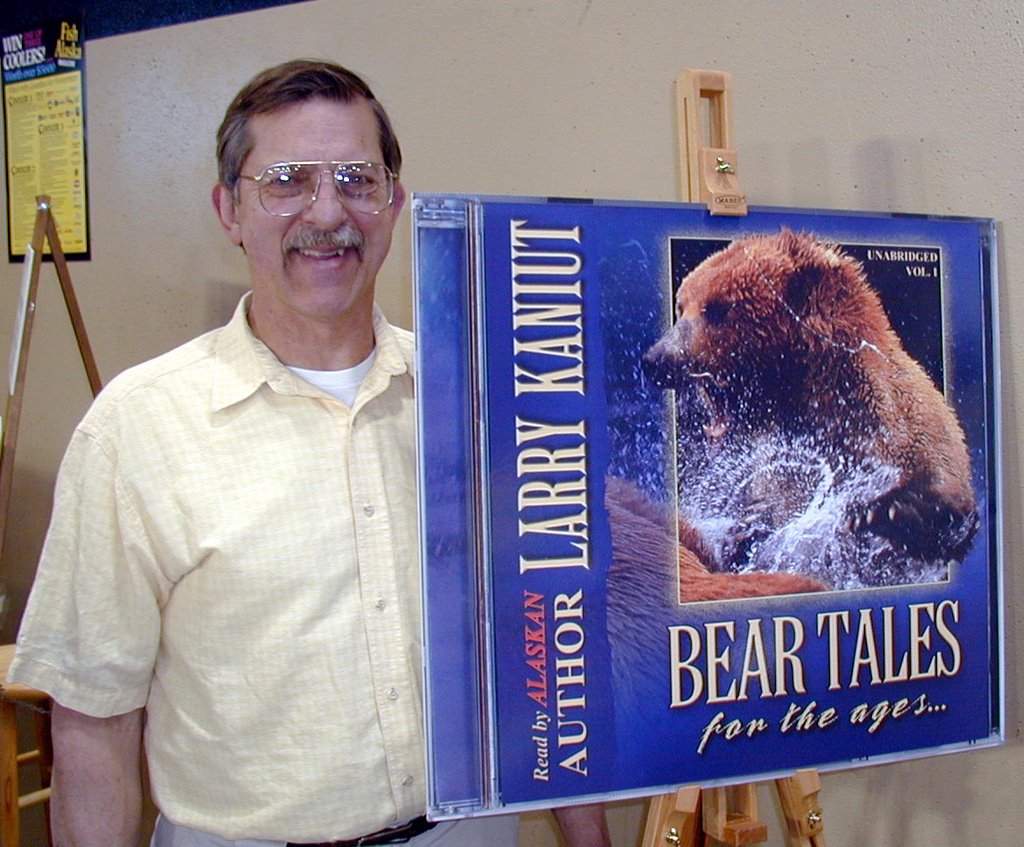 Alaska author Larry Kaniut is well known for his books of stories about Alaska bears -- especially bears who have chewed up Alaskans. Kaniut has a new book on tap -- and this one incorporates his understanding of bear attacks and suggests some strategies for dealing with potentially lethal bear encounters.
Alaska Outdoors Advocacy - The Alaska Outdoor Council
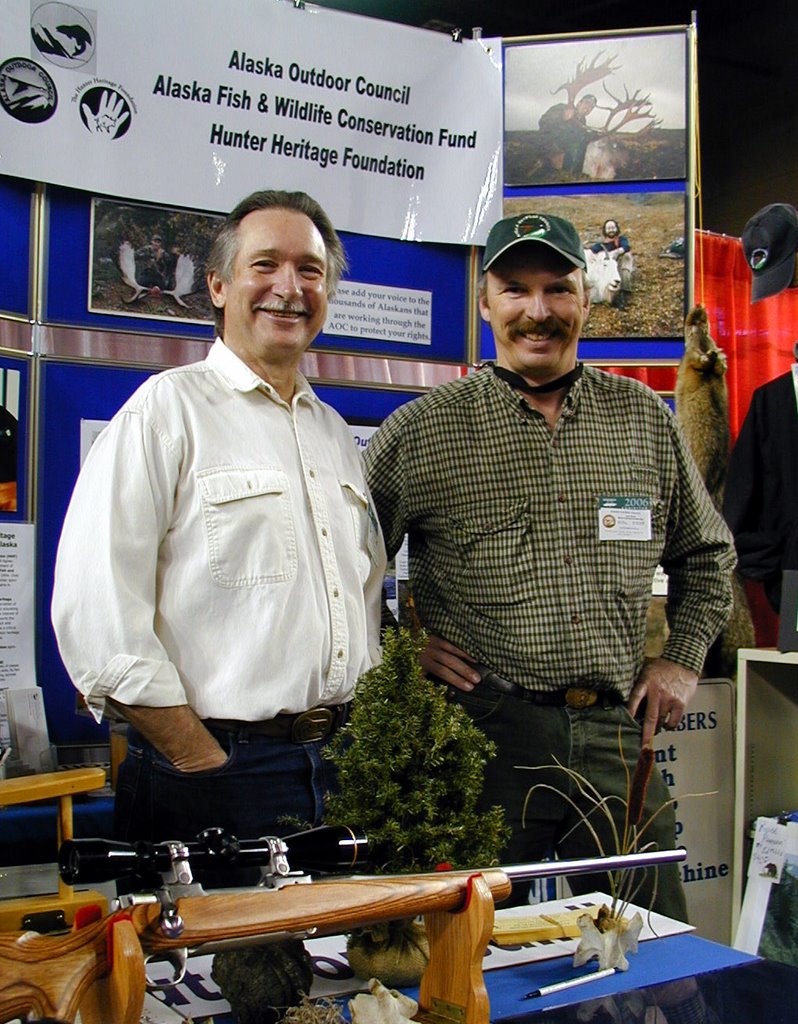 We met up with Alaska Outdoor Council Executive Director Rod Arno at the Great Alaska Sportsman's Show on April 7. Arno and I talked in the interview about the council and why Alaskans and others interested in the Alaska out of doors should consider joining the ranks of membership, either through an affiliated club, or as an individual member.
Oar Saddles - world's lightest rowing frame

The Oar Saddle isn't really a rowing frame, but it does many of the same tricks. If you are considering a river trip where a frame is needed -- but can't take the weight and bulk of a full-size frame, these are definitely worth a look.
Inventor Kent Rotchy tells how they work, where they don't work, and how you can find out more.
Monday, April 03, 2006
Buffoose in Delta Junction?
 Alert Delta Junction residents sent The Alaska Hunting News this picture published in Saturday's Delta News Web, and the accompanying cutline:
Biologists have been concerned about the potential for interbreeding among moose (Alces alces) and bison (Bison bison). Delta is one of the areas in the world where these two species exist in close geographic proximity. Delta area biologist Steve DuBois captured images of what may be the first known instance of a hybrid between these two species. The body of this animal appears moose-like, but the horns appear to be typical of a male bison. It is not known whether this "bull" is sterile, as hybrids often are. Biologists and lexicophilists are working on names for the new hybridized species. Some that have been proposed are buffoose, moosalo, boose, mison, bioose, bisoose, and mooson. A debate is raging among taxonomists on what Latin name to use: Alces buffaloensis, Bison alces, or something entirely new, Aprilfoolsensis critterus. Photo Courtesy Steve DuBois.
Friday, March 31, 2006
Legislative proposal to fund ADFG inadequate: AOC
The Alaska Outdoor Council has called legislative committe proposals to fund ADFG work inadequate. In light of increasing expenses, inadequate salaries to attract the best candidates, and spiraling overhead costs, the AOC is urging Alaskans to support higher funding for the Divisions of Sport Fisheries and Wildlife Conservation.
Thursday, March 23, 2006
Recent Threads on the Alaska Hunting Forum
- alwaysgoing wants to know about the bugs north of the Brooks Range!
- AlaskaCub would like to know if there is any special tricks to care for guns in the saltwater environment on the Alaska Peninsula.
- Jake_65_65 wants to get practiced in the event of a bear charge as far shooting techniques.
- Michael Strahan has some inside information on Adak caribou hunting.
- 9point needs some pointers on how to dry hip boots on a drop hunt.
- LaneW would like recommendations for equipment to take digital pictures through a spotting scope.
- Mr. Grayling is planning a hunt in the Wrangells and would like to know where he can hunt for sheep.
- bizymocha needs a good bannock recipe for in the field.
- 375ultramag is addressing the changes to moose hunting in unit 21D.
- ward17 would like some feedback regarding Joe Want's bear hunting seminars.
- Mr Grayling is going sheep hunting in fall; what exercise and training tips would you give him.
- FALCON would like to know which Cabela's Alaskan Meindle boot he should purchase.
- RANGER RICK is looking for recommendations on what GPS would be good for his son.
- Jeff L is looking for thoughts about exit wounds or no exit.
- niceguy0777 needs help deciding between a .338RUM and the .375H&H.
- AK375HH is going hunting in PWS and would like some meal recommendations.
- blackfoot is curious how brown bear hunters and guides sight in their rifles, and for what range.
Thursday, March 16, 2006
Alaska outdoors show schedules
Alaska has some great outdoors shows. The first one, the Mat-Su Outdoorsman Show starts March 31st in Wasilla. The show organizers recently sent us a schedule for the show. This is a PDF so you can print it and take it with you.
The Great Alaska Sportsmans Show starts Thursday, April 6 in Anchorage. They have also provided us a printed schedule of events for the 2006 show. This is also a PDF.
We're working on obtaining a schedule for the Fairbanks show, and we'll post it here when we get it.
The Great Alaska Sportsmans Show starts Thursday, April 6 in Anchorage. They have also provided us a printed schedule of events for the 2006 show. This is also a PDF.
We're working on obtaining a schedule for the Fairbanks show, and we'll post it here when we get it.
Proxy hunting narrowed to curb abuses
Alaska's Game Board took action on Tuesday to restrict proxy hunting because of abuses, according to the Anchorage Daily News.
"Proxy hunts have increased sharply in recent years, Fish and Game officials say. Some hunters reportedly abuse the practice, though they're not breaking the law.
"Proxy hunts have increased sharply in recent years, Fish and Game officials say. Some hunters reportedly abuse the practice, though they're not breaking the law.
They collect multiple proxies from senior citizens who don't need caribou or moose meat and keep the meat for themselves. Other hunters acquire proxies so they can kill more animals, thus increasing their chance of nabbing trophy game, said Fish and Game spokeswoman Cathie Harms."
The abuses are apparently wide spread, but mainly concentratred in the Nelchina country. Under the new rules, only people qualified to hunt in the area will be allowed to do so. The board also ruled that antler trophies must be destroyed to make sure the game is really being harvested to benefit those for whom the regulations where originally enacted.
Predator control programs crimp wildlife agency budget
Extensive predator control programs require serious funding, according to an Anchorage Daily News story. These programs have been forcing the cash-strapped agency to modify program priorities. The ADN quoted Wildlife Division Director Matt Robus:
"Instead of flying a moose survey every two years, we're flying them every three or four years," he said. "We've pulled back on sheep and goat surveys. "
"Our information for some populations isn't as up-to-date as we'd like it. We're doing less survey and inventory work than we feel we need to."
Robus was talking to the Alaska Board of Game at the beginning of its ten-day spring regulations meeting now going on in Fairbanks.
"Instead of flying a moose survey every two years, we're flying them every three or four years," he said. "We've pulled back on sheep and goat surveys. "
"Our information for some populations isn't as up-to-date as we'd like it. We're doing less survey and inventory work than we feel we need to."
Robus was talking to the Alaska Board of Game at the beginning of its ten-day spring regulations meeting now going on in Fairbanks.
Sunday, March 12, 2006
Hot Threads on the Alaska Hunting Forum
- niceguy0777 would like to know the difference between the .338 RUM and the .338 Lapau Mag.
- Gordo is flying to Alaska in September for a moose hunt and is looking for more information on guns as checked baggage.
- Ak Steve is comparing tents, specifically the Hilleberg Nallo II and the Bible I-tent.
- homerdave provides a link to the proposed new outfitter / guide requirements.
- Josh_AK is purchasing a gun for hunting/back-up protection, he's deciding between a .44 and .480, any suggestions?
- How do you get a fire going, Michael Strahan wants to know.
- David Johnson announces that Alaska's wolf population has doubled from what it was about 20 years ago.
- turner1978 is going on an unguided drop hunt this fall. What should he tip the pilot?
- Michael Strahan wants to know where you go for your outdoor information online.
- blackfoot is curious about Nosler Accubond's performance?
- Michael Strahan starts a valuable thread about the top three tips you'd offer when it comes to surviving a remote Alaska hunt.
- blackfoot wants to know about calling grizzly bears.
- AlaskaCub believes that there may a "Big Caliber Obsession" in Alaska.
- Michael Strahan consolidates the previous threads on guide - client relationships.
- twodux starts a thread on ethical hunting for guides and the expectations clients have about guided hunts.
- waterrat defines subsistence hunting.
- Barron starts a hot discussion on residents and non-residents and how locals in Alaska effect their hunting resources.
- Jasper's wife is going to join him hunting; what's the best rifle for her?
- Kusko is comparing the Ruger 77 Mark II lightweight and the Tikka T3 Lite and wants to kow some opinions on what people prefer.
Friday, March 10, 2006
ADFG advises on Avian Flu
With all the speculation about avian flu, how should Alaska waterfowl hunters regard the birds they take next fall? Alaska wildlife division director Matt Robus wrote this in an article in Alaska Wildlife News.
"As we take these precautionary measures it is important to remember that there is no reason to think that HPAI has reached Alaska, and that it is not certain that it will be brought here by wild birds. In addition, we know of no case where a person has become infected with HPAI from a wild bird. Our best advice is that Alaskan hunters should not be overly concerned about avian flu, but should practice common sense precautions while handling and preparing wild birds. Do not use any birds that are obviously sick, wash up after handling birds and clean your tools and work surfaces, use rubber gloves while dressing birds, and cook the meat thoroughly to kill disease and parasite organisms—all practices that should be used whether or not HPAI makes an appearance here."
More detailed information is available in an ADFG fact sheet on Avian Influenza.
"As we take these precautionary measures it is important to remember that there is no reason to think that HPAI has reached Alaska, and that it is not certain that it will be brought here by wild birds. In addition, we know of no case where a person has become infected with HPAI from a wild bird. Our best advice is that Alaskan hunters should not be overly concerned about avian flu, but should practice common sense precautions while handling and preparing wild birds. Do not use any birds that are obviously sick, wash up after handling birds and clean your tools and work surfaces, use rubber gloves while dressing birds, and cook the meat thoroughly to kill disease and parasite organisms—all practices that should be used whether or not HPAI makes an appearance here."
More detailed information is available in an ADFG fact sheet on Avian Influenza.
ADFG/Wildlife publishes response to game proposals
pThe Alaska Department of Fish & Game has published its reponse to proposals now before the Alaska Board of Game. The response goes through the proposals one by one and gives a department position and brief rationale for the position. This is a PDF report.
Wednesday, March 08, 2006
Dick Burley appointed again to state game board
Former Alaska Board of Game member Richard Burley of Fairbanks was appointed by Governor Frank Murkowski again to the board after a 10 year absence, according to the Fairbanks Daily News-Miner. Burley is a retired printer, with a strong interest in Alaska hunting.
"I don't think it's going to mean much of a change," said Pat Valkenburg, Interior spokesman for the Alaska Outdoor Council, in the News-Miner article. "He's pro-hunting. He's pro-intensive management."
Burley replaces Alaska guide Sharon McLeod-Everette. Murkowski also reappointed Cliff Judkins of Wasilla for another term.
"I don't think it's going to mean much of a change," said Pat Valkenburg, Interior spokesman for the Alaska Outdoor Council, in the News-Miner article. "He's pro-hunting. He's pro-intensive management."
Burley replaces Alaska guide Sharon McLeod-Everette. Murkowski also reappointed Cliff Judkins of Wasilla for another term.
Monday, March 06, 2006
State's wolf numbers double while wolf control goes on
Alaska's wolf population has essentially doubled in the last 20 years, even in the face of substantial state wolf control efforts, according to ADF&G statistics reported by the Fairbanks Daily News Miner.
It is tempting to think that more wolves taken in control programs means fewer wolves in the state. However, just the opposite has actually occurred. From the News-Miner:
It is tempting to think that more wolves taken in control programs means fewer wolves in the state. However, just the opposite has actually occurred. From the News-Miner:
"The increase in wolves is likely due to an increase in the number of moose and caribou from the early 1980s to the mid-1990s, a time during which the state was actively conducting wolf control in several areas, said [ADF&G biologist Mark] McNay.
"Ungulate populations around the state were increasing" said McNay, citing the Mulchatna and Fortymile caribou herds, as well as the Tanana Flats moose population, as three examples.
Is wolf control therefore good public policy? This long term demonstration of the effectiveness of the policy leaves little room for doubt that it works, and that wolf populations can actually benefit. There may be arguments that can be marshalled against wolf management as the right policy for Alaska -- and other wolf jurisdictions -- but the extirpation argument is clearly not one of them.Saturday, March 04, 2006
Boards Question State Fish & Wildlife Enforcement
Concern has been building in Alaska that a Department of Public Safety reorganization early in the Murkowski administration has reduced effective fish and wildlife law enforcement. The reorganization eliminated the Division of Fish and Wildlife Protection, replacing it with the Alaska Bureau of Wildlife Enforcement. Last fall, the Alaska Boards of Fisheries and Game wrote Commissioner Tandeske expressing their concern and requesting statistics. Here is the text of that letter. Public Safety responded at a mid winter meeting of the Boards.
 Dear Commissioner Tandeske:
Both the Board of Game and Board of Fisheries have recently held some of their annual regulatory meetings at which the issue of fish and wildlife enforcement has been a major topic. Quite frankly, public testimony has pointed directly at an obvious decreasing fish and wildlife enforcement presence -especially at some of the more remote areas of the state.
Both boards realize that fish and wildlife enforcement priorities have always shifted depending on the fish and wildlife seasons at hand. In addition, legislative priorities have resulted in vacillating budgets for both the Troopers and Fish and Wildlife Enforcement personnel. However, we are concerned that the recent combination of the two divisions has resulted in less emphasis on our fish and wildlife resources.
Considerable emphasis has been made by this administration concerning the maximum utilization of our fish and wildlife resources to benefit Alaskans. As instructed, both boards have attempted to implement this strategy, along with addressing the ever-increasing social conflicts over resource allocations such as subsistence, sport, commercial, and personal uses. All of our efforts are futile, however, if inadequate enforcement is present to assure that the boards' regulations and plans have a reasonable chance of being properly implemented.
The Board of Game and the Board of Fisheries respectfully request activity statistics from the Department of Public Safety so that we can proceed with our busy regulatory schedule beginning early next year. If enforcement efforts have diminished significantly since the reorganization in August 2003, then it will behoove both boards to examine the enforceability of our specific regulations much more closely.
 We request the following data:
1. All Alaska Public Safety Information Network (APSIN) activity statistics for the Division of Fish and Wildlife Protection troopers from July 1, 2000 through June 30, 2003, provided in monthly printouts.
2. All APSIN activity statistics for all Alaska Bureau of Wildlife Enforcement (ABWE) troopers from July 1,2004 through June 30,2005, provided in monthly printouts.
3. All APSIN activity statistics for the Wildlife Investigations Unit from July 1, 2000 through June 30,2003, provided in monthly printouts.
4. All APSIN activity statistics for the Wildlife Investigations Unit from July 1, 2004 through June 30,2004, provided in monthly printouts.
5. An annual budget summary for the Division of Fish and Wildlife Protection and Bureau of Wildlife Enforcement from July 1,2000 through June 30,2005.
6. All APSIN activity statistics identified in 1 & 2 above for the following posts: Fairbanks, Palmer, Wasilla, Bethel, Kotzebue, Nome, King Salmon, Kodiak, Soldotna, Homer, and Sitka.
7. A comparison of personnel location assignments and filled trooper positions for the Division of Fish and Wildlife Protection and the Bureau of Wildlife Enforcement from July 1,2000 to June 30,2005.
If possible, we would request this information by early January of 2006 so that it can be provided to the separate boards at their January meetings. It will be extremely beneficial in helping us in establishing our regulatory priorities and in making recommendations concerning our fish and wildlife management and conservation responsibilities to the governor and legislature.
Your assistance is greatly appreciated. If you need any additional clarification, please let us know as soon as possible.
Sincerely,
Mike Fleagle, Board of Game / Art Nelson, Board of Fisheries
 Dear Commissioner Tandeske:
Both the Board of Game and Board of Fisheries have recently held some of their annual regulatory meetings at which the issue of fish and wildlife enforcement has been a major topic. Quite frankly, public testimony has pointed directly at an obvious decreasing fish and wildlife enforcement presence -especially at some of the more remote areas of the state.
Both boards realize that fish and wildlife enforcement priorities have always shifted depending on the fish and wildlife seasons at hand. In addition, legislative priorities have resulted in vacillating budgets for both the Troopers and Fish and Wildlife Enforcement personnel. However, we are concerned that the recent combination of the two divisions has resulted in less emphasis on our fish and wildlife resources.
Considerable emphasis has been made by this administration concerning the maximum utilization of our fish and wildlife resources to benefit Alaskans. As instructed, both boards have attempted to implement this strategy, along with addressing the ever-increasing social conflicts over resource allocations such as subsistence, sport, commercial, and personal uses. All of our efforts are futile, however, if inadequate enforcement is present to assure that the boards' regulations and plans have a reasonable chance of being properly implemented.
The Board of Game and the Board of Fisheries respectfully request activity statistics from the Department of Public Safety so that we can proceed with our busy regulatory schedule beginning early next year. If enforcement efforts have diminished significantly since the reorganization in August 2003, then it will behoove both boards to examine the enforceability of our specific regulations much more closely.
 We request the following data:
1. All Alaska Public Safety Information Network (APSIN) activity statistics for the Division of Fish and Wildlife Protection troopers from July 1, 2000 through June 30, 2003, provided in monthly printouts.
2. All APSIN activity statistics for all Alaska Bureau of Wildlife Enforcement (ABWE) troopers from July 1,2004 through June 30,2005, provided in monthly printouts.
3. All APSIN activity statistics for the Wildlife Investigations Unit from July 1, 2000 through June 30,2003, provided in monthly printouts.
4. All APSIN activity statistics for the Wildlife Investigations Unit from July 1, 2004 through June 30,2004, provided in monthly printouts.
5. An annual budget summary for the Division of Fish and Wildlife Protection and Bureau of Wildlife Enforcement from July 1,2000 through June 30,2005.
6. All APSIN activity statistics identified in 1 & 2 above for the following posts: Fairbanks, Palmer, Wasilla, Bethel, Kotzebue, Nome, King Salmon, Kodiak, Soldotna, Homer, and Sitka.
7. A comparison of personnel location assignments and filled trooper positions for the Division of Fish and Wildlife Protection and the Bureau of Wildlife Enforcement from July 1,2000 to June 30,2005.
If possible, we would request this information by early January of 2006 so that it can be provided to the separate boards at their January meetings. It will be extremely beneficial in helping us in establishing our regulatory priorities and in making recommendations concerning our fish and wildlife management and conservation responsibilities to the governor and legislature.
Your assistance is greatly appreciated. If you need any additional clarification, please let us know as soon as possible.
Sincerely,
Mike Fleagle, Board of Game / Art Nelson, Board of Fisheries
Hooter Hunting
Most Alaska hunters are familiar with the grouse and ptarmigan that inhabit the bulk of Alaska. But hooters? Hooters is a local name for blue grouse, the largest of the Alaska grouse, inhabitants of the Alaska panhandle.
Riley Woodford has written about his blue grouse hunting experiences in the most recent issue of Alaska Wildlife News:
"Blue grouse or hooters are sometimes dismissed as “dumb” birds, but that’s not my experience. My first attempt at spring hooter hunting a few years ago left my buddy and I feeling dumb, while the hooters mocked us from the trees."
Riley Woodford has written about his blue grouse hunting experiences in the most recent issue of Alaska Wildlife News:
"Blue grouse or hooters are sometimes dismissed as “dumb” birds, but that’s not my experience. My first attempt at spring hooter hunting a few years ago left my buddy and I feeling dumb, while the hooters mocked us from the trees."
Friday, March 03, 2006
TIP: Alaska Hunt Planning Timeline
Planning an Alaska hunt is no small undertaking. With a few rare exceptions that usually require local knowledge and Alaska residency, it’s an expedition that will require a time investment uncommon to hunts in other parts of the United States. Here are some steps to consider for planning a September hunt.
One to Two Years Out
Select a guide / air charter service. The good ones book early. So should you.
January - February
Everyone wants to hunt Alaska until it’s time to get out the wallet. Get some deposit money down from your partners now. It will reduce the flake-out factor. If you’re renting a raft or camping gear, make your reservations now. Same goes for airline reservations and lodging / rental car if you need it.
February - March
Research a primary and secondary hunt area. The secondary is your backup plan in case things don’t go well with Area One. Get 1:63,360,000 series maps for both.
March - April
Take a second deposit from your group members, so they don’t have to come up with all of it at once. Confirm your hunt locations and firm up your air charter arrangements. Until you send some money to your charter, it’s just a nice conversation on the phone. Send them some money or you don’t have a reservation. Make a deposit on your rental raft. Reserve a satphone or VHF radio if you plan to rent one. Check ADFG harvest stats and start going through your gear inventory.
August
Get the final payments from your hunters, confirm costs for meat and trophy transport / processing, purchase remaining gear, practice with your weapon of choice, do a shake-down cruise with your raft (new raft purchases) and start your physical conditioning. I put this last because I know you’re not going to do it anyway, but it should be on the list somewhere.
Two Weeks Out
Purchase and repack all food, ship dry goods via air cargo to air charter, confirm ship date for rental raft, prepare float plan and give it to emergency contacts (float hunts), confirm air charter details one more time, make meat / trophy expediting arrangements.
Departure Day
Pack frozen / perishable foods and check in with luggage.
Arrival in Alaska
Give a copy of float plan to air charter, collect satphone or VHF radio if renting, make last-minute purchases, check in with air charter / guide.Give a copy of float plan to air charter, collect satphone or VHF radio if renting, make last-minute purchases, check in with air charter / guide.
Tip Author Michael Strahan has been an Alaska Hunting Guide, and is a frequent contributor to the Alaska Hunting Forum. He has written a book on Alaska Float Hunting now in press.
One to Two Years Out
Select a guide / air charter service. The good ones book early. So should you.
January - February
Everyone wants to hunt Alaska until it’s time to get out the wallet. Get some deposit money down from your partners now. It will reduce the flake-out factor. If you’re renting a raft or camping gear, make your reservations now. Same goes for airline reservations and lodging / rental car if you need it.
February - March
Research a primary and secondary hunt area. The secondary is your backup plan in case things don’t go well with Area One. Get 1:63,360,000 series maps for both.
March - April
Take a second deposit from your group members, so they don’t have to come up with all of it at once. Confirm your hunt locations and firm up your air charter arrangements. Until you send some money to your charter, it’s just a nice conversation on the phone. Send them some money or you don’t have a reservation. Make a deposit on your rental raft. Reserve a satphone or VHF radio if you plan to rent one. Check ADFG harvest stats and start going through your gear inventory.
August
Get the final payments from your hunters, confirm costs for meat and trophy transport / processing, purchase remaining gear, practice with your weapon of choice, do a shake-down cruise with your raft (new raft purchases) and start your physical conditioning. I put this last because I know you’re not going to do it anyway, but it should be on the list somewhere.
Two Weeks Out
Purchase and repack all food, ship dry goods via air cargo to air charter, confirm ship date for rental raft, prepare float plan and give it to emergency contacts (float hunts), confirm air charter details one more time, make meat / trophy expediting arrangements.
Departure Day
Pack frozen / perishable foods and check in with luggage.
Arrival in Alaska
Give a copy of float plan to air charter, collect satphone or VHF radio if renting, make last-minute purchases, check in with air charter / guide.Give a copy of float plan to air charter, collect satphone or VHF radio if renting, make last-minute purchases, check in with air charter / guide.
Tip Author Michael Strahan has been an Alaska Hunting Guide, and is a frequent contributor to the Alaska Hunting Forum. He has written a book on Alaska Float Hunting now in press.
Wednesday, March 01, 2006
ORV use off the Dalton Hwy - legislative hearing March 5
This information was passed along by the Alaska Outdoor Council. Whether or not you agree with this legislation, here is a way to make your voice heard in the process.
On Sunday March 5, 2006 at 1:30 p.m. the House Transportation Committee will be taking up HB 85. When passed into law HB 85 will repeal the ORV ban in the Dalton Highway Corridor Management Area, allowing motorized access to millions of acres of public lands in GMU 20, 24, 25, and 26, north of the Yukon River. The members of the House Transportation Committee are listed below along with their contact number and e-mail address. Please respectfully contact their offices to convey your support for this piece of legislation. Information regarding SB 85 is listed directly below. If there are any questions regarding this piece of legislation please contact Senator Seekins Office at 907-465-2327.
Background: A substantial portion of Alaska's landmass lays on the north side of the Yukon River, served by only one road in the entire area -- the Dalton Highway. With very limited exceptions, current law entirely bans the use of off-road vehicles within five miles of the highway's right-of-way starting at the Yukon River crossing at mile 57 and extending 357 miles north to the Arctic Ocean.
Summary: SB 85 Removes the prohibition on the use of off-road vehicles within five miles of the right-of-way of the James Dalton Highway; beginning 12 months after the bill becomes law.
What does SB85 do?
How ORV use is regulated within the Dalton Highway Corridor Management Area, after the passage of HB 85, depends on who participates in the planning process.
House Transportation Committee Members:
CO-Chairs
Jim Elkins 465-3424 Rep_Jim_Elkins@legis.state.ak.us
Carl Gatto 465-3743 Rep_Carl_Gatto@legis.state.ak.us
Members:
Vic Kohring 465-2186 Rep_Vic_Kohring@legis.state ak.us
Mark Newman 465-2679 Rep_Mark_Newman@legis.state.ak.us
Bill Thomas 465-2679 Rep_Bill_Thomas@legis.state.ak.us
Woodie Salmon 465-4527 Rep_Woodie_Salmon@legis.state.ak.us
Mary Kapsner 465-4942 Rep_Mary_Kapsner@legis.state.ak.us
On Sunday March 5, 2006 at 1:30 p.m. the House Transportation Committee will be taking up HB 85. When passed into law HB 85 will repeal the ORV ban in the Dalton Highway Corridor Management Area, allowing motorized access to millions of acres of public lands in GMU 20, 24, 25, and 26, north of the Yukon River. The members of the House Transportation Committee are listed below along with their contact number and e-mail address. Please respectfully contact their offices to convey your support for this piece of legislation. Information regarding SB 85 is listed directly below. If there are any questions regarding this piece of legislation please contact Senator Seekins Office at 907-465-2327.
Background: A substantial portion of Alaska's landmass lays on the north side of the Yukon River, served by only one road in the entire area -- the Dalton Highway. With very limited exceptions, current law entirely bans the use of off-road vehicles within five miles of the highway's right-of-way starting at the Yukon River crossing at mile 57 and extending 357 miles north to the Arctic Ocean.
Summary: SB 85 Removes the prohibition on the use of off-road vehicles within five miles of the right-of-way of the James Dalton Highway; beginning 12 months after the bill becomes law.
What does SB85 do?
- Provides access for average Alaskans to recreate on tens of millions of acres of public land
- Allows the State of Alaska & BLM to create and implement land use plans to provide for recreational development within the Dalton Hwy Corridor.
How ORV use is regulated within the Dalton Highway Corridor Management Area, after the passage of HB 85, depends on who participates in the planning process.
House Transportation Committee Members:
CO-Chairs
Jim Elkins 465-3424 Rep_Jim_Elkins@legis.state.ak.us
Carl Gatto 465-3743 Rep_Carl_Gatto@legis.state.ak.us
Members:
Vic Kohring 465-2186 Rep_Vic_Kohring@legis.state ak.us
Mark Newman 465-2679 Rep_Mark_Newman@legis.state.ak.us
Bill Thomas 465-2679 Rep_Bill_Thomas@legis.state.ak.us
Woodie Salmon 465-4527 Rep_Woodie_Salmon@legis.state.ak.us
Mary Kapsner 465-4942 Rep_Mary_Kapsner@legis.state.ak.us
Subscribe to:
Posts (Atom)